Hardwired for Stories – Mastering Business Storytelling

Share this on:
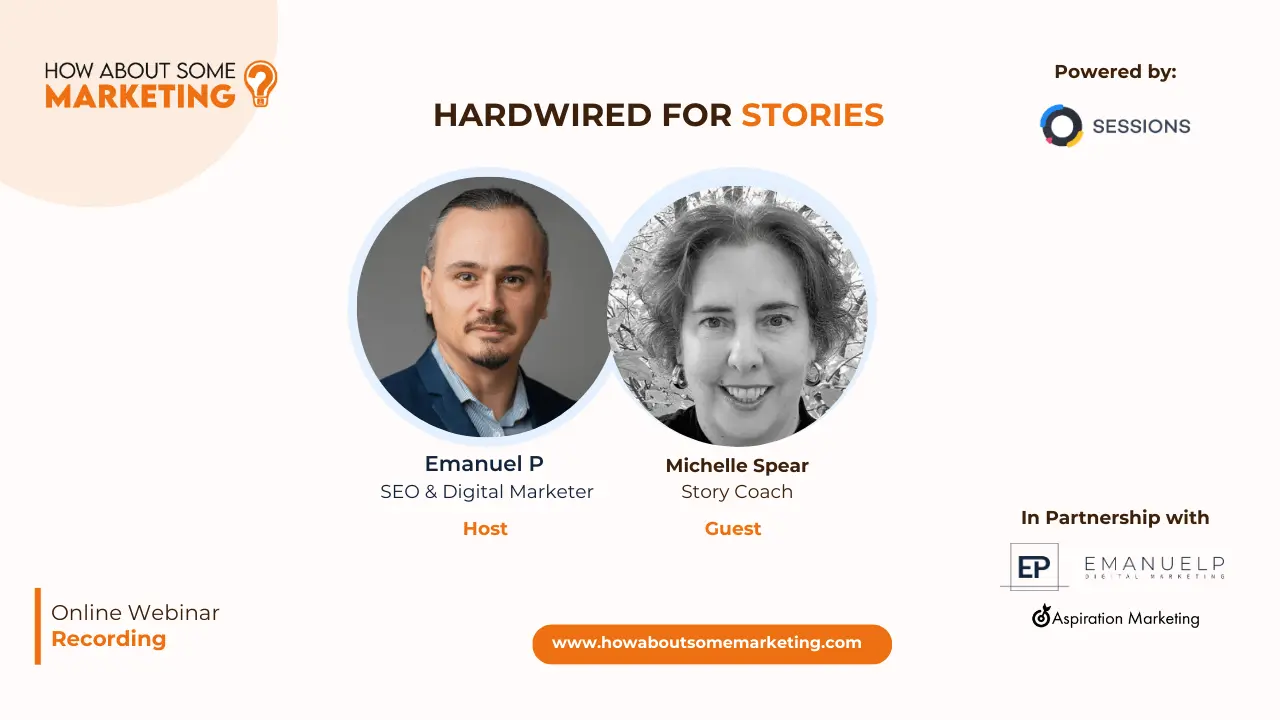
Banner Webinar Michelle Spear - recording Hardwired for Stories - Mastering Business Storytelling

Learn from Emanuel, Joachim, and special guest Michelle Spear about the power of storytelling in business. Discover how storytelling can help you connect with your audience, increase engagement, and build a strong brand. Gain insights on crafting compelling founder stories, incorporating different storylines, and capturing impactful narratives from customers and employees. If you’re a business owner or marketing professional, this video is a must-watch to enhance your storytelling skills and elevate your business strategies.

Get the webinar PowerPoint slides from here

Introduction:
This transcript is from a marketing webinar hosted by Emmanuel Petrescu focused on the power of storytelling in business. Guest speaker Michelle Spear shares insights on how stories can help businesses connect with customers, employees, investors and more.

Key topics covered:

  • Benefits of business storytelling
  • Types of stories businesses need to tell
  • Story arcs and plot lines
  • Sourcing stories from founders, employees, and customers
  • Turning customer/employee narratives into compelling stories

Guest Bio:
**Michelle Spear** is an experienced coach and public speaking mentor. She has over 20 years of experience in coaching and social activism. Michelle is a member of Emanuel’s Toastmasters club and has helped him and others build confidence and skills in public speaking and communication.

**Emanuel Petrescu** is the founder of How About Marketing?, a hub focused on providing marketing education, coaching and resources for small and medium sized businesses. His goal is to help businesses gain more exposure and revenue through search, social media and advertising.

Key Takeaways:
“Stories make us human, and we are all hardwired for stories. We listen and we learn when a story is being told. Our emotions are stirred, and we connect with the storyteller, the hero, and the audience.” (Michelle Spear, 00:50:55)

“I really encourage you, carry around a a notebook or or use your phone or whatever you need to do and and capture stories on a daily basis.” (Michelle Spear, 00:54:24)

Michelle Spear first started working with newcomer women to Canada, helping them stand confidently in front of groups speaking of their experiences. Working with them,

Follow Michelle  👉

►Facebook https://www.facebook.com/MichelleSpear88

►LinkedIn https://www.linkedin.com/in/michelle-spear/

►Instagram https://www.instagram.com/michelle_spear/

►Website https://michellespear.ca/

========================

How About Some Marketing? On Social

► Subscribe to the newsletter 👉 https://www.howaboutsomemarketing.com/
► Subscribe On YouTube 👉    https://www.youtube.com/@howaboutsomemarketing
► Follow Us On Instagram 👉 https://www.instagram.com/howaboutsomemarketing/
► Follow Us On X 👉 https://twitter.com/hasomemarketing
► Follow Us On LinkedIn 👉 https://www.linkedin.com/company/howaboutsomemarketing/
► Like 👍 Us on Facebook 👉 https://www.facebook.com/howaboutsomemarketing
► Join Our Free Facebook & LinkedIn Groups https://linktr.ee/howaboutsomemarketing
► Follow Us On Pinterest 👉 https://www.pinterest.com/howaboutsomemarketing/
► Follow Us On TikTok 👉 https://www.tiktok.com/@howaboutsomemarketing

=====================================================================About Emanuel PHow About Some Marketing? founder and host: Emanuel Petrescu is a Toronto SEO consultant. He’s passionate about helping businesses enhance their reputation and online footprint. Emanuel has substantial experience managing websites and developing and implementing SEO strategies. His area of expertise lies in SEO Audits, a subject on which he has developed a comprehensive educational course.

► Emanuel’s website 👉 https://emanuelp.com/
► Emanuel On YouTube 👉    / @emanuelp986 
► Emanuel On LinkedIn 👉 https://www.linkedin.com/in/emanuelp986/
► Emanuel On Twitter 👉 https://twitter.com/emanuelp986

=====================================================================
Emanuel (Host):
Hello and welcome to another session of our How About Some Marketing? webinars. Today is Thursday, February 29th 2024, a day that only happens every four years. I’m not sure how many times February 29th actually lands on a Thursday, but nevertheless, what better thing to do at 7 PM than join this session?

My name is Emanuel. I’m a digital marketing consultant based in Toronto, and I help small to medium-sized businesses gain more exposure and revenue through search, social media, and paid advertising.

I created How About Some Marketing? as a hub to support small and medium-sized businesses in becoming bigger businesses through education, coaching, and mindset reframing. This is your go-to place for clear, no-nonsense marketing guidance. We focus on actionable strategies and resources designed for real-world business needs—no jargon, no overly complex tactics, just practical insights you can use.

If you haven’t already, go to howaboutsomemarketing.com and subscribe to the newsletter. That’s the one you want to be on.

Now, I’d like to introduce my partner and regular guest, Joachim, to say a few words.

Joachim:
Thanks, Emanuel. I’m Joachim, founder and CEO of Aspiration Marketing. We’re a digital marketing agency based in Toronto with team members in the US and Europe. We focus on helping technology startups and scale-ups grow through web design, inbound marketing, SEO, and paid advertising.

Emanuel:
Thanks, Joachim. Moving on to today’s topic: Hardwired for Stories: The Power of Storytelling in Marketing.

People don’t remember facts, benefits, or features. They remember stories and how those stories made them feel. Whether you’re putting your kids to bed, chatting around the dinner table, watching a movie, or selling a product, storytelling is at the center of our lives.

Our guest today is Michelle Spear. Her bio is available on the website, but I’d like to say a few words about our connection.

Michelle has been a huge inspiration for me. The reason I do webinars, guest podcasts, articles, and social content is largely thanks to her encouragement. We met through Toastmasters—we’re part of the same club—and for the past few years, she’s been a mentor and coach not just to me but to many others. I’ve seen the impact of her insight firsthand, and I’m honored to have her here today as our guest speaker.

Michelle, the floor is yours.

Michelle (Guest Speaker):
Good evening, everyone, and thank you, Emanuel, for that wonderful introduction.

If you have questions during the presentation, please drop them in the chat. Emanuel will be monitoring, and we’ll pause halfway through for questions and a short break. We’ll also address more questions at the end if time allows.

Storytelling takes us from where we are to where we dream to be—places imagined, remembered, or longed for. Great stories stir emotion, build connection, teach, entertain, and inspire.

As human beings, we are the only species that passes down history through storytelling. It’s how we teach, connect, and preserve culture. That’s why we’re hardwired for stories. In business, storytelling can be the difference between a sale and a missed opportunity, between retaining loyal employees and losing them.

Tonight, we’ll cover four key parts:

  • The benefits of storytelling
  • Story arcs or plot lines
  • Five essential story types every business needs
  • Sources for storytelling

Although this is a marketing-focused session, everything I share can also be used in personal branding—job interviews, networking, even dating. The more stories you have ready, the more versatile and memorable you become.

You may want a pen and paper, and keep a phone nearby—I’ll be sharing a few QR codes throughout.

Let’s begin.

Stories help you:

  • Create a brand that stands out
  • Increase engagement
  • Build loyalty with customers and employees
  • Communicate your message clearly
  • Humanize your company

Ultimately, storytelling boosts sales. But you must offer a journey—an emotional connection—so people buy into your message and want to share it.

Even financial or technical presentations can benefit from storytelling. Here’s an example:

“In the last financial year, sales dropped by 5%. For over 75 years, since our founder Larry Cooper started the business in his garage, we’ve delivered the highest-quality products and outstanding service. Each one of you is part of that legacy. But now we ask: if our service is still exemplary, has the market changed—and how can we evolve to meet those new needs?”

This example blends emotion with data. It doesn’t place blame. It praises the team and invites them into a shared mission. That’s what great storytelling in business does.

Michelle (Guest Speaker):
As I mentioned, storytelling can be used in many ways beyond sales. It can:

  • Focus attention on a problem
  • Re-motivate a team
  • Clarify vision
  • Create alignment
  • Inspire action

A quote from Harvard Business Review writer Bronwyn Fryer really captures this:

“If you can harness imagination and the principle of a well-told story, you get people rising to their feet amid thunderous applause—instead of yawning and ignoring you.”

We’ve all sat through mind-numbing presentations. No one wants to be remembered as the world’s most boring speaker. What sets you apart is your ability to use storytelling to draw from real-life experiences—especially founder stories, customer stories, and employee stories.

These don’t even have to be about your company. If you’re presenting to potential partners or clients, telling a story about an employee who volunteers in underdeveloped countries can illustrate your company’s values.

Say an employee helps build libraries abroad. Maybe your business provides the financial support, or generous vacation time, or even contributes to the cause. That says something about your culture. If you’re a publishing company, for example, and this employee builds libraries—there’s a natural synergy. That’s a story worth sharing.

Companies that support employees’ dreams build loyalty.

Personally, I worked for the same organization for 36 years because it gave me the chance to make a difference, stay connected to my values, and earn a living that supported my ability to give back. That’s powerful.

Now, let’s explore types of stories you can use.

I came across a study from the University of Vermont’s Computational Story Lab. They analyzed 1,737 stories from Project Gutenberg—all in English, all fiction—and discovered something surprising: there are only six basic story arcs. Today, I’ll focus on the three most relevant for business storytelling.

  1. Rags to Riches
    This is a continuous upward journey. The character starts at the bottom and rises to success. Think classic immigration stories, or stories of founders who started with nothing and built an empire. This is ideal for founder stories.
  2. Man in the Hole
    The hero starts in a good place, then experiences a major downfall, and eventually rises again. It shows resilience and strength. A good real-life example: the 9/11 attacks—America was hit hard and then recovered. This arc resonates because it mirrors the human journey of struggle and recovery.
  3. Cinderella
    Rise → Fall → Rise. The character starts low, gains power or success, hits a major obstacle, then overcomes it and ends up better than ever. These are stories of transformation, resilience, and redemption.

You’ll notice they all end on a positive note. That’s intentional. We use storytelling in business to inspire and persuade, not to overwhelm with negativity.

Now let’s look at the five essential stories every business needs to develop. These usually follow one of the three arcs:

  • The Founder Story
  • The Why Story
  • The Vision Story
  • Customer Success Stories
  • Employee Success Stories

Let’s start with the Founder Story.

This tells how and why the company or brand was created. It’s often told by the founder, but every employee should know it well. It forms the cornerstone of brand messaging, ties all parts of the company together, and leaves a lasting impression.

Take Patagonia, for example. Their founder story is exceptional. You can look it up or scan the QR code if you grabbed it earlier.

If you’re not the founder, ask if the story has been written. If it hasn’t, consider interviewing the founder and writing it out. If you are the founder, these are the elements to include:

Michelle:
Key Elements of a Great Founder Story:

  1. Identify the Pain Point
    What was missing in the market? What challenges did the founder experience?
  2. The Realization
    When did they decide they were the one to fill that gap?
  3. The Journey
    What obstacles were faced—funding rejection, people who didn’t believe in them, setbacks? What kept them going?
  4. The Values
    Include values like:

    • Vision
    • Resilience
    • Adaptability
    • Leadership
    • Passion
    • Problem-solving
    • Integrity
    • Industry knowledge
  5. The Impact
    What’s the company doing now that makes a difference?

Founder stories can be used everywhere: websites, marketing materials, speaking events, hiring, and PR. Don’t shy away from mentioning the tough parts—the struggle is what makes the story real.

Let me give you a full example: the story of Timothy Eaton.

Michelle:
The Timothy Eaton Story

Timothy Eaton was born in Ireland in 1834. Ten years later, the Great Famine devastated the country. At age 20, he immigrated to Canada and settled in Ontario. With help from his brothers, he started a bakery that failed within months. Undeterred, he opened a dry goods store, and eventually purchased another one in Toronto.

When WWII came, Eaton sent 3,000 employees to the front lines—and continued to pay their wages to support their families. They displayed photos of these employees proudly in the Toronto store.

By the end of the war, Eaton’s employed 70,000 people across the country. In 1905, they hosted the first-ever Santa Claus Parade in Toronto.

Back when Irish immigrants were rejected by employers, Timothy Eaton hired them. My own Irish grandmother worked for Eaton’s. That store gave opportunity where others refused.

Eaton also introduced practices that revolutionized retail:

  • Fixed pricing (no haggling)
  • Cash-only sales (to reduce financial risk)
  • A money-back guarantee
  • The first mail-order catalog, reaching rural communities with everything from furniture to farming equipment

Those are now standard practices, but Eaton did them first. He created massive community impact and helped generations of families succeed.

Yes, Eaton’s eventually closed—but its legacy still lives on.

Founder stories like this are memorable because they show hardship, integrity, and perseverance. Drama makes the story stick. Real struggles overcome with honesty inspire trust.

Michelle (Guest Speaker):
Let’s move on to the second essential business story: the Why Story.

This one reveals purpose. It’s vulnerable, honest, and often emotional. It’s not always about profits. It might be about a passion, a desire to change the status quo, or to give back.

Many founders simply want to do meaningful work. Others build their companies around social responsibility. These are the social entrepreneurs—they don’t just make money to make money. They reinvest into causes they care about, their communities, or nonprofit initiatives.

Today’s consumers want that. They care about purchasing with purpose. But don’t jump on every trendy cause. Your “why” must be authentic, specific, and consistent.

It’s hard to find true Why Stories written down. You’ll hear them at conferences, in podcasts, or keynotes, but rarely on company websites—because they’re personal. But your why helps shape your vision. Even if you don’t share it publicly, you must be crystal clear about it.

Let me share mine.

My Why Story

Ever since I was a child, I had an irrational fear of becoming homeless—what I called the “bag lady” fear. I didn’t grow up poor, but I heard stories of women whose husbands left or died. There were no pensions, no savings, and because many of these women were stay-at-home moms, they didn’t qualify for benefits or support.

They ended up in shelters, on the streets, or eating cat food to survive.

That terrified me.

By age six or seven, I decided I’d never depend on anyone financially. I worked hard, but even in the 80s and 90s, it was a man’s world. Wage gaps were wide. It took years of struggle to feel secure.

As I got older, I witnessed more poverty and realized the strongest solution was to empower women—because when women succeed, families succeed.

That’s my why. My deepest motivation is to help women break the cycle of poverty and give their children a real chance at a better life. That purpose drives my vision.

Now we move into the Vision Story.

This is where you excite imagination and inspire belief. Numbers and goals are the language of planning. Vision is the language of purpose.

A vision story is not a mission statement. It’s emotional, dynamic, and rooted in long-term impact. It helps preserve business culture and identity. It increases employee loyalty and customer trust.

This story evolves with your business. It helps set short- and medium-term goals. Your long-term objectives stem from your mission. But your vision story is what your people rally behind.

When you write your vision story:

  • Clearly state the end goal
  • Explain the strategies to get there
  • Be specific, emotional, and detailed
  • Use sensory language: what does it look, sound, and feel like?
  • Use adjectives to paint a vivid picture
  • Be authentic and focused
  • And write it down—because you’ll be telling it over and over again

You need to believe it. If you don’t, no one else will.

My Vision Story

My coaching practice allows me to create meaningful impact. I partner with social service organizations to sponsor women living in poverty and train them to become certified life, health, or business coaches.

For every $115,000 in profit, I can sponsor one woman—covering all her training, qualifications, and credentials.

This career gives her the flexibility to care for her family, financial independence to escape poverty, and the dignity of earning her success. If each graduate gives back to the program, we can continue growing and support more women each year.

That’s the big picture. That’s my vision.

And here’s how that vision becomes a Vision Statement:

“My vision is to break the cycle of poverty by providing women with the opportunity to thrive through coaching.”

It’s short and public-facing, but it comes from a much deeper story. Your leadership, board, or investors need the full vision story. It’s your internal compass.

Next, let’s explore the final two types of stories you need.

Customer Success Stories

These showcase real outcomes: improved efficiency, safety, working conditions, satisfaction—whatever matters most. Use testimonials, reviews, and case studies. Focus on before-and-after impact. Combine emotion with data.

Employee Success Stories

Perfect for recruitment, but also to demonstrate community involvement and culture. These stories can highlight internal development, charitable initiatives, or how your team grows within the company.

Ask your team for their stories. Celebrate them. These narratives humanize your brand and show what it’s like to work with you—not just for you.

All five stories can be used across:

  • Company marketing
  • Personal branding
  • Fundraising
  • Events
  • Networking
  • Even casual conversations

You might be wondering—do I really need to know all these stories if I’m not in sales, marketing, or the founder of a company?

Yes, you do.

You never know when you’ll be called on to:

  • Give a presentation
  • Motivate a team member
  • Onboard a new employee
  • Speak at an event
  • Or even just answer a question about your company at a dinner party

Being prepared with stories helps you communicate with clarity, confidence, and connection.

I know a man who was frequently asked to speak at different events—conferences, business functions, community clubs. Because no single speech worked for every audience, he kept a cheat sheet in his wallet.

His list included:

  • The story title
  • The key learning points
  • And a call to action, if needed

This allowed him to insert the right story into any talk—on the spot.

Over time, he became known as a dependable emergency speaker. Eventually, he got booked so often that he left his day job to speak full-time.

Stories don’t always need to be about business.

They can be:

  • Personal
  • Moral or ethical fables
  • Stories that illustrate behavior or lessons
  • Or classic parables, like:
    • The boy hammering nails into a fence to learn about anger and forgiveness
    • The tortoise and the hare
    • African folklore like “The Lion and the Mouse”

These can all be powerful when used appropriately in business settings to teach values, explain ideas, or inspire reflection.

But to be effective, you must know your stories inside and out.

Practice them. Sharpen them. Make sure they sound natural. A great place to build storytelling skills is Toastmasters. It’s a worldwide organization that helps people improve communication and leadership, and I highly recommend it.

Now let’s talk about where to find stories.

Some stories are obvious. Others take a bit of digging. As I go through the sources, feel free to add your ideas in the chat.

Story Sources:

  1. The Founder
    Interview them if needed. If a story already exists, review and update it. Always get final approval before sharing publicly.
  2. Employees
    Ask:

    • How did you discover this company?
    • What do you love about working here?
    • What does our brand mean to you?
    • What’s your biggest contribution to our success?
    • What goals do you have, and how has the company helped you achieve them?
  3. Customers
    Ask:

    • What problem were you facing before working with us?
    • What’s your favorite part of working with us?
    • How did our product or service help you reach a milestone?
    • What was the emotional experience—before and after?
    • How can we continue helping you succeed?

Also use:

  • Customer surveys
  • Feedback forms
  • Online reviews

When you hear a great story, write it down.

Here’s a simple structure you can use to craft stories from customer or employee input:

Story Formula:

  1. Problem or Pain Point
    Describe the challenge or need. Set the context.
  2. The Solution
    How did your product, service, or company address it? Highlight specific programs, tools, or departments involved.
  3. The Results
    Share qualitative and quantitative outcomes. Use data where possible, but connect emotionally too.
  4. The Emotional Journey
    Describe how the person felt before and after. What changed for them?

Important:
Always get permission to share someone’s story. Some may be okay with their name and company being used; others may want anonymity. Respect their boundaries. Share the final version with them before publishing.

You can use stories across all types of media:

  • Videos
  • Blog posts
  • Websites
  • Social content
  • Webinars
  • Sales decks
  • Presentations

And always remember to include a call to action. Invite your audience to connect, solve their own problem, or take the next step. Don’t leave the story hanging.

We’ve covered a lot of ground tonight.

Quick Recap:

  • Benefits of storytelling
  • Three story arcs: Rags to Riches, Man in the Hole, Cinderella
  • Five business story types: Founder, Why, Vision, Customer Success, Employee Success
  • How to source stories
  • How to structure them effectively

You already have a library of stories inside you. Use them. They create empathy, connection, and lasting impressions.

Storytelling is the oldest and most powerful way to create change. It helps people relate, understand, remember, and act.

We’re all hardwired for stories. They stir emotion, build trust, and make you human.

So don’t be afraid. Tell your stories.

Thank you, Emanuel, for the opportunity to speak. And thank you to everyone who joined us today.

If you’d like coaching on developing your story library, you can connect with me via the QR code on the screen. I’d love to help.

Emanuel (Host):

Thank you so much, Michelle. Before we wrap, we have a couple of questions from the chat.

Question: What are the key elements of a compelling business story? Should we combine the Why and Vision stories?

Michelle:
Great question. For older companies, it can be tough to track down the original vision. But you can start by asking current leadership what their vision is today. Hopefully, it’s still rooted in the original intent.

Yes, you can absolutely blend story types. A compelling business story might start as a founder story, then fold in your why and your vision. What matters most is that the journey is clear, honest, and emotional—challenges included.

Emanuel:
Here’s a comment that just came in:
“I work as a therapist and use stories often to help clients see things differently. Metaphors are especially useful. Thank you for such a powerful talk.”

Michelle:
Thank you—that’s lovely to hear. Stories are healing and transformative, in therapy and in business.

Emanuel:
Any final remarks?

Michelle:
Yes. Keep a notebook—or use your phone. Capture little moments from your day. Things you notice. Challenges overcome. Even simple events can become meaningful stories. The more real and grounded they are, the more powerful they’ll be.

Emanuel:
Thank you again, Michelle. Thank you to everyone who attended or watched the recording.

A reminder: our next How About Some Marketing? webinar is happening Thursday, March 28th at 7 PM EST. The topic is branding—how to set your business up for success (or failure if done poorly). My guest will be Dan Kuet, a seasoned entrepreneur and business development consultant.

To register, visit howaboutsomemarketing.com. And don’t forget to subscribe to the newsletter so you never miss an event.

This is Emanuel Petrescu, founder of How About Some Marketing?, signing off. See you next month.

Share the Post:

Related Posts