
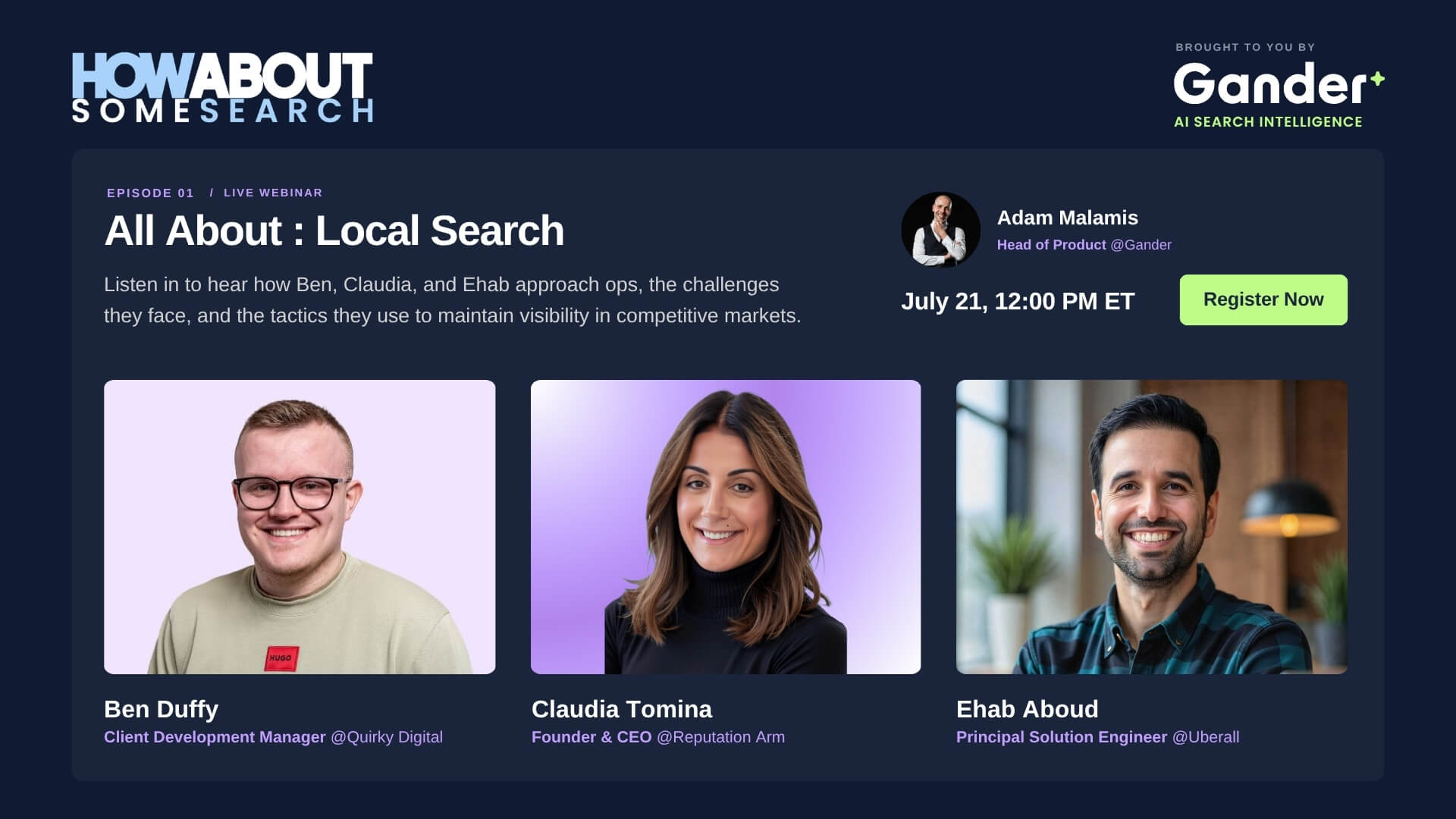
Welcome to How About Some Search, powered by How About Some Marketing. Hosted by Adam Malamis, this episode brings together three industry experts: Ben Duffy from Quirky Digital, Claudia Tamina from ReputationArm, and Ehab Abood from Uberall.
The panel covers Google Business Profile optimization, local SEO versus traditional SEO, AI search visibility, multi-location operations, reviews, reputation strategy, maps, directories, and how local businesses need to think about Search Everywhere Optimization.
Brought to you by Gander AI Search Intelligence.
Watch The Recording
Topics Covered
- Local SEO versus traditional SEO
- How AI search changes rankings
- Google Business Profile optimization
- Multi-location strategies
- Reviews and engagement
- WhatsApp for conversions
- Reputation management
- Search Everywhere Optimization
Key Takeaways
- Local SEO fundamentally differs from traditional SEO: it combines website optimization with Google Business Profile optimization and proximity-based search results.
- Reviews are non-commodity content that AI engines heavily rely on to understand and recommend businesses.
- Multi-location businesses need a location marketing platform to maintain data consistency across directories.
- AI search across ChatGPT, Claude, Gemini, and other platforms means local businesses need to optimize for search everywhere, not just one platform.
- Response time is critical: answering leads within 5 minutes increases conversion likelihood dramatically.
- WhatsApp integration can drive more conversions for local businesses than traditional contact forms.
- Negative reviews can provide useful data that trains AI models and helps customers understand who a business is right for.
- Social mentions and influencer recommendations are becoming part of the local discovery picture.
- Business category matters. Restaurants, law firms, plumbers, and other sectors need different optimization strategies.
- Data consistency and structured data across your website, GBP, and directories is essential for AI visibility.
Panelists
Ben Duffy
Ben Duffy is a local SEO strategist and agency owner at Quirky Digital.
Claudia Tamina
Claudia Tamina is the founder of ReputationArm and a Google Product Expert.
Ehab Abood
Ehab Abood is a Principal Solution Engineer and Product Expert at Uberall.
Resources Mentioned
About Adam Malamis
Adam Malamis is principal and owner of Blue Goose, specializing in high-profile government and nonprofit websites. With 25 years of design experience, including 20 in UX, Adam brings deep expertise in complex systems.
As head of product for Gander AI Search Intelligence, an AI search intelligence platform for B2B marketers, he understands how businesses rank across traditional and AI-driven search.
Show Notes
Key Concepts
- Local SEO versus traditional SEO: focus on maps, proximity, and Google Business Profile.
- Google Business Profile verification video requirements and challenges.
- Multi-location suspension recovery process.
- Search Everywhere Optimization across directories, platforms, and AI tools.
- Structured data and metadata importance for AI search.
Platforms and Directories
- Google Business Profile and Google Maps
- Yelp, Apple Maps, Facebook, and Bing Maps
- ChatGPT, Claude, Gemini, and Perplexity
- Ask Maps
- Clutch
Tools Mentioned
- Uberall
- Gander AI Search Intelligence
- Whitespark
- Google Search Console
- Bing Webmaster Tools
Full Transcript
Adam: All right. Hello and good afternoon, everyone. Welcome to the first episode of How About Some Search. I'm your host, Adam Malamis, and today we're gonna dive into local SEO. We're joined by a panel of three experts: Ben Duffy from Quirky Digital, Claudia Tamina from ReputationArm, and Ehab Abood from Uberall. Welcome everyone.
Ehab: Thank you, Adam. Thank
Ben Duffy: you. Thank you.
Adam: Ben, would you mind introducing yourself, please?
Ben Duffy: Yeah, of course. I'm Ben from Quirky Digital. So we're a SEO agency based in Liverpool in the north of England. So my role at Quirky is I'm basically in charge of our local SEO team. So I create the strategies, make sure they're working, generating results, and then I'm very hands-on with dealing with clients.
Adam: Awesome. Thanks, Ben. Claudia?
Claudia: Claudia Tamina, founder of ReputationArm. We are a SAS platform that helps local and multi-location businesses show up on maps listings across the web. We also do a lot of reputation management, NPS management. I'm also a Google product expert, and so I can troubleshoot pretty much anything Google Business Profile.
Adam: Cool. Thanks, Claudia. Ehab. Yes, Ehab
Ehab: Ehab Abood, based in the north of England as well, not too far from Ben. Though Uberall is originally a German tech company now global with about 400 people. I'm a principal solution engineer. There similar to Claudia, I'm a product expert, but I, very much look up to all of Claudia's efforts. But it's just a, it's just a product expert tag for me. But yeah, we do similar things to ReputationArm. We are friends in the industry yeah, a lot of overlapping overlapping knowledge and clients, that kind of thing. I think we cover just over 1.6 million locations through our platform globally. So yeah, that's what we do.
Adam: Wow. Thanks, Ehab. Okay, team, let's just jump right in. The first question I have not being a local SEO expert is, how does local search optimization differ from what we would classically call SEO? Ben, you wanna kick us off again?
Ben Duffy: Yeah, definitely. So local SEO is a lot different from traditional SEO, what you call it, because with traditional SEO, it's all about those blue link results appearing at number one. You're getting more traffic through to your website and then ultimately trying to convert it. Whereas with local SEO, there's the a- added element of your Google Business Profile. It's showing proximity to where you are. So say for example you're... With traditional SEO, you're trying to buy a new pair of pants. You're typing buy pants or buy a particular brand. In a lot of cases in traditional SEO you'll go to Google, click on the blue link, go through there. But with local SEO, it could be- Looking for a- an accountant near me. So then when you search with near me, it's actually the Google Business Profile that's showing up before you actually get to those blue links. So for me, a lot of it is making sure you've got a good business profile, it's all been optimized, so you can actually start to attract more engagement, get more visibility, and drive in more people through to your website or more calls that way.
Adam: Okay. And Claudia, I know you work more on the reputation side. How does that kinda differ?
Claudia: Yeah Ben did an excellent job explaining the difference between local and organic SEO. I'll just add that for local SEO, definitely your reviews matter a lot. It- it's gonna determine if you're gonna rank for specific keywords. It's also how you optimize your Google Business Profile. So your- your business name matters for the local map pack ranking, your structured data, like your business categories, the services that you have listed. So this is all stuff that's not necessarily on your website, but within your Google Business Profile. So it's a different set of ranking structure. Everything matters though. It's a combination of the landing page attached to your Google Business Profile, the data on the landing pages, everything needs to be looked at. And so your Google Business Profile, there's a lot of sections in there that help you rank and making sure you're optimized fully for all that's gonna help you in local SEO.
Adam: Okay. Ehab.
Ehab: Oh, so well put. I don't know how I can follow that. I think maybe the only thing I'd say is really a common pitfall that people follow, and this probably exposes the difference is those who follow sort of typical SEO strategies when they go into the world of local SEO, they find themselves in, in a bit of a bother, mainly through suspensions. And it's because they'll... Basically, most of their efforts in local SEO will be considered as like maybe keyword spamming or some sort of spamming, or there's not enough information that's been submitted on your listing, or you don't have much of a web presence. So Google goes, "Oh I don't think this location is real, so I'm not gonna, I'm not gonna pop it up on, on, on Google Maps. I don't think it's legit." even if you're a well-known brand, we have clients who go through this every single day, even if they've got five, 10,000 locations, individual locations will still get suspended or won't be surfaced for that same reason where someone's consulted an out and out pure SEO agency that doesn't know anything about local SEO and just said, "Cool, we're gonna do the same," and it doesn't work. Whereas Ben's agency, some others, for example obviously they know a little bit more about that, so that, that's not where you go through those pitfalls.
Adam: Fair. And so when you have a multi-location business like that, how do you deal with those suspensions if some locations are in the pack and then others aren't?
Ehab: That is the million-dollar question really. There's so much to go through. First you check your profile, make sure... Or also you check your guidelines to make sure you're not y- you're not breaching the guidelines. Then you you go to support, you ask, y- you ask them for some help, and if they can't help, then you go to Google Business Profile forums where someone like myself or Claudia, I've not been active for a few months, but someone like myself or Claudia will be able to help and point you in the right direction. And maybe in some occasions escalate with our own con- contacts into Google to say, "Hey, by the way, support haven't been doing their thing." But usually that's the generic path. Obviously case-by-case basis, but that's it.
Adam: Okay.
Claudia: I will add that I think a lot of people have been in business for years, and they've had their business profile up for 10 years. They might make a slight edit and then trigger a suspension because what Google is doing is they're doing an integrity check. And so now there's a lot more systems in place that are doing checks across the web. And so if there's some inconsistencies, you may trigger a suspension. So it's not necessarily that you edited your hours that triggered the suspension or that you added a new user, but that created the integrity check and there was some type of mismatch. And Google's not very transparent with why things happen. It's up to the business to figure out which guideline they're really violating, because everything in their documents are very vague. And it's really, sometimes it's very difficult for the average business owner to understand what exactly they did or what... because they've been in business for 10 years and never had any issues. And so in their minds, they're completely legit, why are they suspended? Why is Google doing this to them? So you do have to do a little bit of research. You can get a lot of help in the forums. There's a lot of s- great stuff that's published. There's so many help articles, but sometimes just going straight to the forum is easier, and then you get to be, have an expert pinpoint exactly what your issue is. But that's where working with a local SEO expert really comes into play. So multi-location brands, they really need to work with somebody that's a local SEO expert because there's a whole 'nother set of ranking factors and SEO that goes into it that somebody like a website designer is not really gonna understand the nuances. And so that's where lo- specialized local SEO experts come in handy.
Adam: Okay. Ben, anything to add?
Ben Duffy: I do think so. I think Claudia and Ehab have really explained that quite well. I think for me, I'm a lot of it on the other side of the issue, where I'll be looking at a client's website and then, a, a business profile, sorry, and I'll just see that it's gone down. And then they've both said you've got to go through the regulations, see where you're violated, and then going through the process of actually trying to get it back up. I know it's become a lot more difficult at times because I know now Google wants you to do the business verification video, which in a lot of cases I know it's been a bit of a, a red hot topic. I know a lot of SEOs like myself very much hate it just because, especially if you're a local electrician, for instance, you're paying for a virtual office because you're going out to jobs all day and then your business profile gets shut down. It's a case of how they'll get that back up. You don't want to be having to travel all the way to a virtual office to try and verify that you're a genuine business. So it's a very ... Puts a lot of business owners in a very difficult situation.
Adam: I can imagine, especially with how many people are, solopreneurs or home o- have their own home office or any number of things. Yeah. Yeah. To address the most prescient change in our industry over the last 18 months, how has AI search changed the way that you guys are optimizing for local? Claudia, would you like to start?
Claudia: So yeah AI is really, for me, has really made an impact as far as me, the lens that I have, where, you know, before it was very traditional local ranking factors. It was somewhat easy to manipulate. I think now because AI is just using everything across the web, everything, all the directories are so much more important. A lot of clients hate Yelp. I don't care about Yelp, but I always historically would say I, understand that you don't like Yelp, but the search engines like Yelp, and they trust Yelp. So we gotta make sure that you're listed on Yelp and Apple and Bing and, everywhere else because if the search engines trust it, then... and you're listed there, they're gonna trust you more." But it's even so much further than that. It's review diversity across all these directories are gonna make such an impact. And then having the right content on your website is even more important. Historically for restaurants, I do a lot of restaurant Google Business Profile management, you can get a restaurant to rank very well without having a really optimized website page with all the data that you needed because there's so much structured data in a Google Business Profile with the menus, with the reviews, with the attributes, everything that Google's looking at. But now with AI, because it's scanning the website and then referring back and linking back to your website possibly, it's really a lot more important to have everything in place. So you can't leave holes. You have to make sure that you're looking at everything holistically and piecing it all together so that the engines can really understand your brand.
Ehab: I think Claudia hit the nail on the head. I'm currently observing as well that there is almost like a convergence between like old school SEO tactics such as like ensuring you do have the right content on your website, that kind of thing. But at the same time, what Claudia mentioned is, really structuring your data on local, especially when you're making sort of local searches in AI, in ChatGPT, in Gemini, Claude, wherever you're going. If that data is structured in the local space, the transition for AI is you've pretty much already got it there because AI really loves structured data. Whereas those who are transitioning from classic blue link SEO to the world of AI, there's a little bit more of heavy lifting to do. So I think actually there isn't too much in terms of change, but obviously there are tools like Ask Maps, which in the UK we don't have just yet and a few others. But those are, helping the journey. But in terms of optimizing as a business I think if you're optimizing for local, you're almost always optimizing for AI with some exceptions.
Adam: Okay. Ben?
Ben Duffy: The last bit what Ehab just said, I think is absolute, that hit the nail on the head there with if you do traditional and local SEO right, you are gonna rank on your ChatGPTs, your Claudes, your Geminis. At the moment we're getting a lot of inquiries from clients, local clients now who they're starting to use your, the AI tools for everyday questions. They're seeing a lot of information out there about it, and they're asking us, "Oh, can we do this GEO?" Or, "I wanna be seen more on your ChatGPTs, your Geminis." But when you actually walk into the actual campaigns, they are showing up there a lot. And I think one of the main things, and something that I always push to my clients when, that we're trying to get them more visibility across these type of tools is your reviews. For us, getting reviews sometimes from clients can be like pulling teeth because they're business owners, they've got a million things that they're looking at on a day-to-day basis. So going out and reaching out to former clients and trying to get them to leave reviews on their own Google Business Profile can be an absolute pain. But for us, we're saying to them, "If you're getting more reviews across all your different entities, it's gonna help you with AI," which is something that from discussions that we've had they're really, interested in. I think it's as well a really exciting time for local SEO when it comes to AI, because I think there's a lot of opportunity that's gonna come up. We're starting to see it now, but I think over the next 18 months to two years, we're gonna see a lot more people using your AI tools as opposed to going through traditional search. So I'm really excited to see the journey and although it'll put a lot more stress on us SEOs, at the end of the day, it's an exciting time, so I look forward to seeing it.
Adam: I couldn't agree more. I think that it's a really exciting time and it feels like we're, circa 1998 on AltaVista some days, right? So it's it's been fascinating for me. You mentioned something that was really interesting around ultra-local search. Paraphrasing here, a couple months ago, ChatGPT got almost to like a level of ultra-granularity where you can use a, a near me, and I might be saying maybe a quarter, let's say ago. Have you guys noticed a, a large difference in terms of the, the actual answers that are coming through? And are you noticing differences between the, the various AI gen platforms as far as what local search looks like?
Ben Duffy: I'd say so, yeah. I'd say you tend to-- I think with most people with AI at the moment, especially across a lot of the local clients that we have at Quirky, you're getting most of it from ChatGPT because I think to everyone ChatGPT seems to be the default AI tool that people go to. I know for myself we use a lot of Claude and, other AI tools, but I think ChatGPT seems to be the main one and what that's pulling data from. And I know with ChatGPT that a lot of it is scanning your Reddits, your Googles, looking at reviews from a lo- a load of different places. So I think ChatGPT for me is the main metric to look at with local because you're dealing with people who are looking for very specific services. Whereas your more tech-savvy people they'll tend to be looking for external- look at using external AI tools like we do in the agency. I don't work on them a lot in the Forex space, and they'll use so many different AI tools because they're very tech-savvy people. Whereas in local, if you're looking for a plumber, it tends to be your everyday person. They're not always going to be tech whizzes, so to speak, so they'll just go to ChatGPT now and ask that particular question because they think it's going to give them the answer, and then it trusts it straight away without knowing where it's pulling the information from.
Adam: Okay. Claudia, are you here?
Claudia: Yeah. I was just gonna add that when I think of ChatGPT, I do think of listicles lists and Yelp top 10. It just, my head just goes there. I don't see that as much in, in AI mode actually in the beginning, but I think it's toned down a bit. But yeah I, believe that there are... Like we live in a bubble, us marketers, and we think that everybody's using all these like soph- they're not that like traditionally a lot of my family members are still defaulting to Google Maps or Apple Maps. And so I think the us marketers really also need to focus on how's our client's profile showing up in Ask Maps? How are we showing up in brand searches? What data is presented? Are, is the know before you go answering all the right questions? So I tend to default there a lot with my clients and I don't necessarily let a lot I kinda recommend not to worry about all the different AI tools and just say "Let's make sure that we can get your brand story the right way across maps, across AI mode Google, and then have your reviews diversity in place." So reviews on Google, maybe a refresh on TripAdvisor. Obviously Yelp and all, even Facebook because there's a lot of AI tools that are looking at your Facebook reviews and not necessarily just defaulting to Google. So review diversity is one way to kinda make sure that you're showing up in all the AI spaces, but it's really hard to get recommended and make sure that you're consistently getting recommended in all these different AI tools. So yeah it's, one of those things you have to just keep focusing on reviews
Adam: All right. Ehab, anything to add?
Ehab: I think just from what Claudia just mentioned I'm just the, the name in my head that's coming up is Darren Shaw from Whitespark. And- If any- anyone doesn't know Whitespark, they do an incredible ranking factor survey every year or two. AI has been a pillar that's been added in the most recent one. But a term that he has used quite a lot, I don't think he coined it himself, but he's made it famous, which is search everywhere optimization. And just on this point- Yes ... of reviews on, local, on the, the gajillion different AI LLMs at the moment that are out here, if you just follow the fundamentals and try to hit as man- excuse me, as many of those fundamentals as possible you're gonna be in a pretty solid place. I'm not gonna try to optimize for Claude over ChatGPT over Perplexity or someone else. Just just hit the fundamentals, search everywhere optimization, you're good to go.
Adam: Okay. That leads me into my next question around the, what's the relationship between you're looking at like a, a Google Business Profile, their website, these numerous third-party directories like Yelp or UGC, like Reddit. How do you decide where to put the hours? Ehab, let's start with you.
Ehab: Oh, okay. There's a, small company called Uberall who can help- ... with things like this. But like jokes aside that's, exactly what you should be doing. You should probably be hitting all of them, but or as many as you can. But if you find a location marketing platform that can help you with that, that'll make your life a lot easier. Things like if you've got, if you've got 10 locations, if you've got one location, if you've got 1,000 locations, you're gonna face similar problems, which is being able to keep that information consistent between your GBP, between Facebook, Apple, Yelp, whatever it might be. And then on top of that, your website. Your website is actually probably the most authoritative publisher outside of Google when Google's looking elsewhere for your web presence and making sure back to an earlier question, if everything's all legit and fine. So it's how do you focus on keeping those consistent, keeping the formatting consistent, because sometimes if the formatting's a little bit off, then Google and some of the other crawlers treat these addresses, for example as different and then potentially might start creating duplicates for you, and then you've got a whole heap of other problems. If you have that with one location, with 10, 1,000, 100,000 you're just scaling that problem, but that problem still exists. If you're able to keep that consistent then that makes your life a lot easier. And then of course, those are the same reasons that will then help you become more visible, as well as avoiding things like losing verification or suspension, that kind of thing too.
Adam: Okay. Ben, Claudia?
Claudia: I was going to add one of the things that I've done in the last year or two and traditionally never did before for local was, you can go into different AI search engines. You can ask what's the best restaurant in s- in, the area or the best plumber, and then look at all the references and the directories they're referencing. And you will find that social influencers play a big role and your own social feeds. So social media for the small business owner is, has to become a lot more relevant. Even if you don't have a huge following, I don't think that's necessarily going to hurt you. I think not posting on social media will hurt you more. So you have to have some type of presence on your social media and then hopefully you can get some influencers to mention your brand as well, and that will go a long way. I always said social mentions are like the new reviews and it, does hold a lot of weight. I think it's as relevant as Reddit. It's not always as easy to get mentioned organically on Reddit and in some categories it's almost impossible to get mentioned in a Reddit thread. So another way to get mentioned is through social media and influencers and even micro-influencers. They don't have to be these huge influencers like we all think they are. Just any, even any parent that's going to mention your brand and your story and... Will just go a long way. Think in terms of mentions and not only reviews.
Adam: Okay, so it almost feels like personalized reviews at scale when you're adding to stories or something like that, where you're, you've got now an audience that trusts that person and it just adds a totally new layer of credibility.
Claudia: Correct. Yeah. Here's the best example. There's a social media profile that has like halal meats and- this I wanna call her a blogger or influencer, all she does is visit restaurants that sell halal meats, and then she posts about it and her whole feed is that. So obviously search engines know that, it's a type of blogging style. It doesn't necessarily have to be a website, it could be somebody's social media profile, but it's a trusted authority. And so if she mentions you, it's almost guaranteed that you're gonna get referenced that way. And it's such a powerful way to stay and get recommended by AI. Going into all these different search engines, doing the searches, and I know I've used Gander as a tool to do a competitive analysis and I learned that Clutch was a good directory to be on. And so you and I talked about that and I- Yeah ... I got on Clutch and I got myself a couple reviews there and soon after I got a recommendation from Claude. So I, don't know if that made a difference entirely. It's, it's hard to do the attribution, but like those are some of the ways that you need to be thinking and then expanding your footprint digitally across all these directories.
Adam: Yeah. Yeah. Thank you. And it's, interesting, right? I've run an agency myself now for 20 years, and we've, Just because we focus so much on government and nonprofit, we do zero sales, right? It's all tender work. Yeah. So I'd never thought. And then when you start to look at what's the best WordPress agency or something like that, even if it's highly localized, like best WordPress agency in Toronto or Chicago, but you could also say best in Illinois or in Ontario, and Clutch and similar directories have so much impact there, at least for the agency space. Sorry I cut you off there, Ben. Do you have anything to add?
Ben Duffy: No. I think it was all covered quite well. I think as Ehab said optimizing for everywhere, I think that's the only way you're gonna get tangible results now. And then five or six years ago, you had a good website that worked well. You had a business profile with a couple of reviews. You were sorted. You were getting loads of leads coming in. Everyone was happy. But with all these tools now, I think it's so, far and wide to what you can do. You've just gotta make sure you're putting in a bit of time everywhere. And I think that's why a lot more people now are looking to speak with external agencies because they've not got the time to spend all this, all the time doing a little bit for your AIs, your business profile. They wanna speak to someone who's gonna take that pressure off them, and that, that's where people like Quirky come in, et cetera, to come in and take that stress away and to do the work and provide those results.
Adam: Okay. So we've talked about a, a lot of different types of businesses. Ben, you had mentioned a plumber. Claudia, you've talked about restaurants. And of course, Ehab, you're talking about large multi-location businesses. So what kinds of considerations are there with different types of local businesses? So for instance, if you're dealing with maybe a five location ma and pa shop versus a, a company that has a storefront versus one that doesn't. Are there any differences in the way that you handle both tactically and strategically? Are there any differences around conversion too? Whoever would like to start, let's just jump right in.
Claudia: I can start on this one. Yeah I, don't necessarily look at whether it's multi-location or not, but I will primarily focus on business category. So I know from experience, like personal injury lawyers, for example, it's really hard to rank your personal injury law firm. So I tell my clients or prospective clients, "Look at your Google Business Profile as a bottom of the funnel." So if you get referred from somebody or you get found through another, another avenue, not necessarily through a search result, somebody's gonna do a brand search on you, and then what are they gonna see? How many reviews are they? Can they trust you? Do they... do... Are you telling the right story? Do they feel a connection when they're looking at your business profile? So I work with a few personal injury lawyers, and a lot of them have... They, have videos of them speaking on subject matter expertise, and we post that on their Google Business Profiles. So that's how I might do- handle that business category. Obviously, restaurants, it's different. I want to make sure that they have happy hour posts, they have any live entertainment posts. The whole posting strategy's obviously gonna be a little bit different. And then when you're dealing with service-based companies, it's before and after photos. It's, obviously reviews are gonna go a long way for all categories. But yeah, I always like to make sure that everything is looked at with a lens of bottom of the funnel. If somebody searches your brand, what are they gonna see and are we telling the right story? And then take it from there.
Adam: Okay. And so you're really optimizing for know before you go, especially in restaurants or any kind of local entertainment establishments.
Claudia: It's hard to optimize for know before you go because it's just based on the data. I'm trying to do some studies to see how often it's refreshing. But at the end of the day you can influence it by making sure your content on your website is there, and then also in, within your Google Business Profile- the way you structure your menus. And the hours that you have, just a lot of your contact us pages. Everything matters, and you have to play around with it, but... And then hopefully it the refresh will bring in the right data that you want to tell. But it's, not something that's super easy to optimize for, like before where traditional local SEO it was. Now with the AI, it almost has to catch up.
Adam: Okay. Ben?
Ehab: I think I could probably speak on the multi-location versus single location comparison. I think the smaller in terms of the quantity of locations the more there is an element of education to, to the customers and teaching them about the impact and where to get the right data, et cetera. The challenge that I see the bit- the larger the organization is actually- How to streamline and get all of that data centrally in one place and one source of truth before it basically goes into Google Business Profile via the likes of Uberall, for example. Those are the biggest challenges I see, but again, as Claude just highlighted, like the, the business categories are really I really see a difference there. More in, again, in like the maturity and education. The law firms they know a lot more of what they're talking about. Car dealerships, they're incredibly competitive environment, so they- they've been on it for quite some time. Same with real estate agents, or at least the real estate agent chains in the UK. And then there's like others like sort of EV and like fuel, who, operate slightly differently where they've got slight different rules. Like I don't know if many people know, but electric vehicle charging stations, they have an entirely different set of rules from every single other business category on Google Maps. Such as being able to feed in live availability data and where that comes from. That doesn't come from Google Business Profile. You have to partner up with other businesses to be able to, get that or beg Google to connect directly to you and for them to accept this really stringent data. So, there are different sort of considerations to take and yeah, whether it's multi location or not, or different categories that, yeah we see, it all over the place, basically.
Adam: Okay. Ben?
Ben Duffy: So this is a question I love being asked about conversions, talking about it, because ultimately as an SEO agency, it's what clients measure us on a lot of the time, is how many people are going through and converting, how much money are they making? And I think before you get there someone's come through either for your Google Business Profile or they've come through your website, et cetera, it's understanding what it is that customer wants to do. So for example, if someone's looking for an accountant, they're gonna wanna fill in a contact form because chances are there's, they're getting quotes from a few different firms to find the best price in order to then make a decision. Whereas if you're a plumber or something, most people are getting in touch with a plumber usually is if they've got a leak or a toilet's leaking or they've got an issue. With that, they either wanna call someone straight away or they wanna click someone, whether that's WhatsApp or a general live chat, because they need to speak to someone now. They need this problem sorted yesterday. So it's very urgent, and I think in order to, show success with a local SEO campaign, you've gotta really hone in on what is it that the, your clients or your business's customers actually want to do. So I know at Quirky with, a lot of the industries that we work with, I always find that WhatsApp is the best option for local businesses because most businesses use it anyway, and most business owners have it on their phone anyway. And for them, they, a lot of them say if they can speak to someone, chances are they're gonna close that lead. And within our local team, if I'm going in and adding a WhatsApp live chat to a website, they, everyone jokes and calls it the Ben Duffy special by just going in, adding a WhatsApp live chat, because to them it they, to me, I see it being done and then it works, and they're all like, "Oh yeah, yours was right there." So I'm very, passionate about, that and about having WhatsApp live chat or then for accountants that we work with, making sure they've got a contact form which has got the information that they need, but isn't too long someone gets halfway through and thinks, "This is too long. I'll go to someone else where it's quicker."
Adam: So you've mentioned something that's really interesting. The Ben Duffy special. Okay. So- ... looking at that, you get a, chatbot. Now, is this connecting to a live person or is this AI gen?
Ben Duffy: A lot of it is a live person. We do have some clients who do use an AI tool. That tends to be more like your mortgage brokers and accountancy firms where the questions are quite evergreen. Can you help with this service? So for example, with accountancy it may be like, "I run a charity, can you help me with bookkeeping or payroll?" You can get an AI chatbot to answer that question. Whereas I'd go back to the, the plumber again, everyone's gonna be sick of plumbers by the end of today. A, a plumber, if someone's looking for a plumber, you're not gonna ask a question how much is it gonna cost. The person who's trying to find a plumber is that desperate, they just wanna speak to someone now. How much is it and when can you come and fix it? That's all they want to know.
Adam: Yeah. Yeah, I've been there myself before- ... and when, the water's off you're like, "I just need someone here now." Yeah,
Ben Duffy: exactly.
Adam: I loved what you said there around the chatbot, because it, to me it seems like that would be such an amazing source of Q&A and then content for AI search. Have, has any of the practitioners here, have they, have you guys had a chance to, mine chatbot data at all or any kind of customer data, especially when it comes to AI search?
Ben Duffy: We haven't, no, not really. It is something I have thought about, but I feel like on the, list of priorities, probably just a little bit lower down, because we're still getting used to we're just... A lot of us at the moment, it's just delivery results.
Adam: Fair. Fair. And you also mentioned WhatsApp and conversion there. I- it's funny, I was talking to one of our, developers yesterday, and I'd mentioned to him that WhatsApp is if we ever to get into the Latin American market, WhatsApp is by far one of the, the largest advertising vehicles, and I thought that was amazing. And then we read a study that says if s- a lead comes in, if you answer them within the first five minutes, you're 100 times more likely to convert them. So that kind of instant recognition and being able to speak to a person seems to make a huge world of difference. I find that fascinating, just how different it is than pretty much any other kind of larger B2B business. Fascinating to me.
Ben Duffy: Definitely.
Claudia: Yeah, I'm not surprised by that at all. I'm the same way. If I could get, if I could get somebody to answer my call or me- text me back immediately, I'm more likely to engage and continue through the process. And then by the time somebody else gets back to me, it's like, "Oh, I'm already done." It's, off my checklist.
Adam: Yeah.
Ehab: Yeah. Yeah. What a- I, will contact five or six people, and if four of them haven't responded, that's that... Ultimately, that's their loss because whether it's a plumber or whether it's another need or whatever it is, you're not gonna wait around for people. You're, busy with your own lives. And sometimes the, business demand or the personal demand takes precedence over, oh, this other business has got a thousand extra reviews on Google, for example. It's more I need something now. Or I'm just not willing to wait because we live in an era where we just want things straight away as well. There's a combination of that, yeah.
Adam: Yeah, and it also makes our lives a lot easier if we can just get the problem done now. We only have so much mind share and cognitive ability throughout a day, right? So to me, that's it's fascinating. I think it's probably one of the most challenging and yet one of the most filled with opportunity landscapes that we possibly could see for small businesses right now. So when we think about reputation, what role does reputation play in today's overall ecosystem, and how do you advise clients to deal with bad reviews? Claudia, I think this seems like a, a perfect question for you to start with.
Claudia: Yeah, I just... I did a LinkedIn post recently with my last one, and it's basically correlating reviews with non-commodity content. Google's always talking about non-commodity content, and I just keep thinking like reviews are literally the def- by definition non-commodity content. You can't... It's unique. It's it's the exactly what the AI engines are looking for, and it's the best way for you to get that content and be recommended with the AI in the LLM. So yes reviews are play a huge role, and they're just gonna keep expanding on your brand, your story, and everything that you need to tell us. So yeah, big focus on reviews, NPS feedback even. Taking all those feedbacks and putting it back onto your website is also gonna go a long way. And then I typically like to mine the review content for FAQs to put on the website. So if you have a lot of reviews that mention your attire that's needed, if you have a strict code for your outfits and, or like the atmosphere or you wanna talk about gluten-free or anything specific and stuff that you specialize in, you can mine through your reviews and then add that content onto your website and it's gonna go a long way.
Ben Duffy: I agree. I think reviews are so important, and I think they're only gonna become more important as time goes on. And when it comes to good and bad reviews, I feel like in a lot of cases, people put a lot more emphasis on positive reviews over the negative reviews. But to me, I think it should be a shift. Your negative reviews are the ones that pe- you should put more time into. It's understanding why that review's happened, making sure you've responded to it in a timely manner. If you get a good review, a very generic response, "Thank you for this five-star review, we r- we really appreciate it," that's enough. But if it's a, a bad review, you're not just going to put a, "Thanks for the review." It- you wanna get into the depths of it. Why has that happened? Has someone genuinely had a bad experience? Is it a competitor? What is it to why someone's left the review? And I think answering those types of questions within your reviews really do help to show your business in a positive light, even in the case when you get a bad review, because I think- with some businesses as well, you can't escape getting bad reviews. I think, yeah we, do work quite a bit in the addiction sector. And- in, in, in that type of niche, I think you're always going to get bad reviews because the experience that you can have at a facility can be very subjective to whether it's good or bad. You may have done the best job possible, but if that's not helped that person, and- something's happened later on down the line, they're gonna be inclined to leave you a bad review. So I think it's understanding the, nuances of it. But, and and as well on a, bit of a tangent, I think reviews as well are massive in terms of your ranking. So this fun- funnily enough happened earlier on today. I got a Google Business Profile live this morning. We got two or three reviews off there already today, and it's already ranking number two in the map pack for the main target term. That was between, I think I got it live at the, about half nine UK time this morning. By 3:00 it ran- it's ranking, in the top two. So-
Adam: Wow ...
Ben Duffy: It shows how important they, really are.
Adam: Okay. And yeah, when it comes to, multi-location and let's... I won't take the example of a plumber right now, but let's go with law firms for instance. How do negative reviews kind of impact multi-location businesses differently?
Ehab: I think if I'm really honest, I think it just scales the concern or the opportunity. I think everyone's really touched upon it, responding to positive or negative reviews. I don't think one should think they're mutually exclusive. I think you should be able to respond to both sets and when it beco- when it comes to a stage of having hundreds or thousands of locations that consideration just has a, just a much bigger impact, but it's the same consideration. I don't know if it's still valid, but for the longest time at Uberall we've preached about Google having this, this ideal of being able to respond to reviews within 18 hours. Now if someone leaves a review on Friday night and you're a Monday to Friday business and you come back on a Monday and you've already missed that, that's a bit of an issue. Obviously we've got solutions to be able to help with that, especially no text reviews a couple of templates, et cetera, that kind of thing to make life easier. But I also wanna touch about on ear- earlier versions of your, question really and I think Claudia mentioned it too, about basically reviews teaching AI. And I really find that, quite a dominating idea at the moment. If you think of AI almost being this new search engine and trying to replicate what the likes of Google have done for a gajillion years. In fact, at Uberall I do a session called _What If We Created a Search Engine From Scratch_. And how best to learn from that. And you'd replicate a lot of what customers or people in the public would do. I, as someone who seeks out halal food like Claudia mentioned earlier the only way I can do that is if I go into the reviews of a restaurant and I search the word halal. I didn't know, for example, that Five Guys most- like around the UK, they've got a dedicated page for that, because I- I only just happened to have discovered it. I would instead go to the reviews, and that's because everyone is talking about them there. So being able to respond to those, being able to make- ensure that people's voices matter that, that goes a long way because then that will encourage more and more reviews, and then you get more and more of those keywords that people are looking to- to rank for. And then of course, in the world of AI, now I just search for what are the nearest halal restaurants to me that are dog friendly, that do oat milk matcha lattes all that stuff and have a baby highchair. You now have a good idea of exactly what my life is like right now. And those are the searches that I actually do wherever I go. Like I went to Scotland a few weeks ago, that's exactly what we do and, then I find a very specific list of locations. It really narrows it down and saves me from hours of research.
Adam: Amazing. Okay.
Claudia: I actually wanted to... If I could just add in, like- Please ... I actually really believe negative reviews help businesses more now than ever before. Because they're training the models, and there's so much more sentiment in that negative review that's being extracted, and it's not always such a negative. Maybe it was a negative for that specific consumer so it brought the average rating down, but for other consumers, being able to extract the data from it, it's not always a negative sentiment, right? And it's... It- r- the way you reply, too, is gonna matter. But I, was helping somebody in the forum, and they were so upset because they got a negative review because somebody was grossed out by the fact that they use beef tallow for- their oil. And I was like I love that. I'm coming to your restaurant because you use beef tallow. And I was trying to explain to him that it's not a bad thing and you shouldn't remove the review, and he was just c- he was so passionate about me escalating the review. So I always will in the forum, but it- it's... Can you imagine the data that was i- being produced teaching the LLMs? And if it wasn't for that review, nobody was gonna know that they use beef tallow and maybe that would bring in a customer rather than turn them away. So I, honestly believe negative reviews are not that negative as much as we think.
Adam: I think that example is really key too where you saw my initial re- reaction. I'm not gonna yuck someone else's yum at all, right? That sounds delicious to me. Yeah. Tell me, you have duck fat too, and I think I'm in, right? Like- Yeah. So with, those kinds of that kind of engagement, right? I, read that local ranking is influenced by how many times people are interacting with a profile, how often they're looking at photos. That's really stuff outside of our control as search professionals. So how do you advise clients to, influence any kind of engagement, if at all? Whoever wants to start, please just jump in
Claudia: It's really hard because you don't like it's, that day and age where we're constantly being bombarded with surveys and text and promotional things. So you really wanna find the balance and make sure that it's organic. And then now with Google's algorithms being able to interpret rating manipulation a lot better than they were before- so a lot of people are, or were engaging in certain types of campaigns with QR codes in the store and grand opening events, and then getting spikes in reviews only to find that those reviews are gonna go missing. So you really have to find the right balance. I think just investing in review campaigns organically, touching on every customer, like at the right touch points, and every business is gonna be a little bit different. And you may have to experiment a little bit too, and make sure "Do I contact them the day after? Do I wait two days?" Every business is gonna be a little bit different, and it's something that le- like needs to really have thoughtful consideration from the brand.
Adam: Okay. Ben, yeah?
Ben Duffy: I think with engagement, being in an agency setting, it's, it is hard because to us it's really important data to look at, and it helps us to show that things are going in the right direction. But in a lot of cases, explaining that to a client who's paying us a monthly retainer can be very difficult. It can be like, oh, engagement's going well, but if they haven't made, haven't had any leads or they haven't had as many leads, they're still asking the question what's the point in this?" So it's a very difficult situation to be in. So I think the way you explain it really helps to say "Oh, no we're seeing people clicking through. People are, looking at things. They're just not yet converting." So I think it's understanding that journey instead of where a client's gonna go to their destination, "Oh, I've had all this engagement where's my money?" Ultimately, which in a lot of cases it lead, it can lead to some difficult discussions, but I think it's all part of the education piece that you have with clients when you're on board in the early months to help show them that it doesn't go, you don't go from A to Z straight away. There's all the steps in between before you get there to that desired outcome.
Adam: Okay. Ehab?
Ehab: I think in terms of engagement, I see it in sort of two forms. There's there's obviously the reviews and social element. But also there's the element of for example, on Google Maps is, photos and videos, ensuring that you've got great photos and videos. As a business owner, you can add a bunch, but obviously of- you're also impacted by what members of the public are adding, which then could either positively or negatively skew people's perception of your business. So for example, if someone posted a bunch of photos or videos of rats or cockroaches at a restaurant, not just a generic photo, then obviously that would be quite negative. But to Claude's example earlier, if you posted someone someone creating some salivating food photos and videos you- it's probably going to invite them even, more. So I'd, probably strongly think about that. But actually we have customers who on a multi-location level internally create like an incentivization, process with photos. Where they look for the photo or video of the month and provide someone with a Starbucks gift card or something like that. Those are submitted internally, and then the business get to- Upload those as the business owner. And that's a great way to be able to showcase the business in a way that sort of meets the brand identity. But then also on the other end, if you're talking about sort of the reviews I've recently advised a travel agency, again, hundreds of locations around the UK. One thing I learned from the re- the real estate agency market is that they like to showcase their most favorite reviews physically on really nicely made posters in their branches. And they're sort of- Oh ... Creating like this aspirational sort of level of this is your 15 minutes of fame on our local branch. They're becoming a local hub that people want to become famous on. So I advise that to the travel agent, and I would actually advise that to a lot of others as well. Especially s- kind of what Claudia mentioned as well, where Google are becoming a lot more stringent. They're talking a lot more about coercion for- reviews as opposed to bribery. Whereas this is a way to actually try to get more reviews without constantly badgering people for reviews. Obviously you could put QR codes on receipts, on on point of sale systems, that kind of stuff. But when it's up there, it does something else, because someone else wants to be there instead. I know personally as a local guide, I would probably want to be on there too.
Adam: Oh, that's so interesting. I, it's like you read my mind, because I was going to ask how are you going to encourage customers to, take photos organically? In a restaurant I think it's pretty easy. You can put a mural with a name over top of it and it adds to that kind of influence, or you have something you can take your backdrop against. But what are other ways that don't necessarily trigger Google's stringent review process?
Claudia: I know Google has that contribute tab. So as a local guide, if you go inside maps, you're gonna see contribute. And so any photo that you have taken during that... If you searched a business, they're gonna correlate any photos you took on that same day that you visited the business and then try to encourage you to post the photo. So you're not posting a review, you're just posting the photos. And so that could be a, way that Google's not gonna remove the photo down if your customers are posting photos. So you, have mentioned a lot of great tips and that would be like one really great way to do that. And then also when you save a business in your list, Ask Maps will reference it more often because it knows that you liked it and saved it. So getting your clients to engage, even if you're a plumber, I always think, okay this is my plumber. Like just go in Google Maps and save me as plumber on your, list so that you'll never forget me. And if they happen to look for a plumber two years later using Ask Maps, they're almost 100% getting recommended because it's on their save list
Adam: Okay. Ben?
Ben Duffy: There are a, a lot of great points there. I, definitely agree that trying to encourage people especially with, the images to, to really get them in really helps. With some of our clients as well, especially in industries where it's not as glamorous, the glitz and glam, it's, it can be difficult, so you've gotta be very selective in how you get that to really display and to show people there's people behind the brands. Like some industries like we've worked with like roofers, et cetera, where they can take pictures of before and afters of roofs, which is what people wanna see. They've done a good job, quality workmanship. M- like mortgage brokers, they... A lot of them that we see, they tend to, with people's consent, post pictures of people outside the new houses which they've done the mortgages for. And that really helps because when people are looking at those types of images, they're thinking, "I want to be them," so they wanna speak to them. But especially if you're like an accountancy firm, it's quite hard to, get those kind of glamorous pictures because most of the time people are... They're doing VAT receipts, they're doing bookkeeping, payroll. It's very unglamorous to, to the untrained eye. So it's very much understanding and making sure that if you're showing yourself off, it's understanding the people behind that. So that's where like your team photos and everything come into place.
Adam: Cool. Okay. So we've got about five minutes left. Are we ready to enter the lightning round?
Ben Duffy: Yeah, I look forward to it.
Adam: All right. So Ben, we'll start with you, Claudia, and then Ehab, and we'll just keep that going for the rest of the lightning round. Sound good?
Ben Duffy: Yeah.
Adam: All right. Most overrated local SEO tactic?
Ben Duffy: Blog posts. Okay. Claudia?
Claudia: Setting up your service area inside your Google Business Profile.
Adam: Okay. Yeah?
Ehab: Oh, you stole my one. I'm very anti keywords at the moment, so I'm gonna say stuffing a gajillion keywords. That's my one.
Adam: Awesome. Okay. First thing you look at when handling a Google Business Profile?
Ben Duffy: Reviews.
Claudia: Categories.
Ehab: Photos and videos.
Adam: Okay. One free thing that every business listening should do this week.
Ben Duffy: Check your Google Business Profile, and if you've not got many reviews, go off and reach out to people to get more. It's gonna make a big difference very quickly.
Adam: Okay.
Claudia: That's a good one. I would say add some photos that really describe your business better and what... Any photos and videos, add them on.
Adam: Okay.
Ehab: Oh, you stole my other one. You read my mind. I would say probably do that regularly. Photos and videos regularly, not just once. They influence what's it called? The recency flags, for, Google. So that it's probably a cop-out to copy Claudia's one, but I'd say doing it frequently.
Claudia: Oh I'll add to it. Make sure you add captions to your photo.
Ehab: Ooh, good one. Great.
Adam: Good one. Okay. One industry that absolutely needs local SEO but is late to the party. And if it's plumbers, I'm closing the podcast right now.
Ben Duffy: Trades. So pl- electricians Ah. Shaved it.
Adam: So trades?
Ben Duffy: Yeah.
Adam: Amazing.
Claudia: I would say wealth management, financial management comp services.
Adam: Amazing. Ehab?
Ehab: Electric vehicle charging stations so, on the rise. That's good. Yeah.
Adam: Excellent. Okay. Last question. Does the MatPack still exist in three years? Yes or no
Claudia: Yes, but less visible.
Adam: Ooh
Ehab: I'd say it almost doesn't matter because Google Maps will still exist. So even if it's not on the search engine results page, it doesn't matter because those top three will still, exist in Google Maps.
Adam: Okay. Ben, Claudia, Ehab, thank you so much for taking the time to chat with me today. This has been lovely. Where can everyone find you?
Ben Duffy: For me, yeah, best place would be LinkedIn at BenDuffy3.
Adam: All right.
Claudia: For me also LinkedIn, and you can subscribe to our newsletter on reputationarm.com.
Adam: All right.
Ehab: And for me, I'm just Ehab Abood on LinkedIn. Even my URL is forward slash Ehab Abood, one word.
Adam: Perfect. Okay, thanks again everyone, and thanks to our sponsor Gander AI Search Intelligence. Wow, I hadn't tripped up this whole podcast, and here we are right at the end. Thanks everyone. Have a wonderful rest of your day, and thanks for tuning in. Take care. Take care.
Ehab: Thank you.
Adam: Thank you.
Ehab: Bye.