
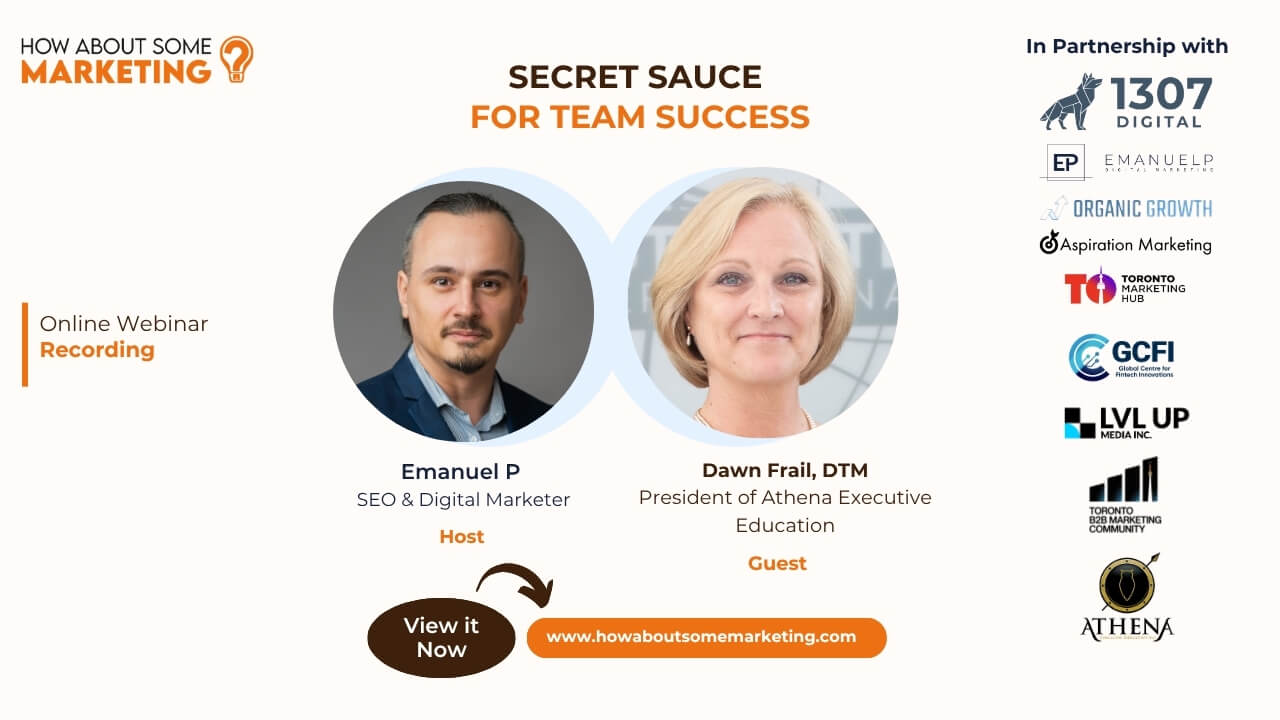
Are you looking to build a stronger, more effective team? Join us for a conversation with leadership expert Dawn Frail as she shares practical strategies for creating trust, encouraging healthy conflict, and driving team success. Discover real-world tips you can use to improve collaboration and results – whether you’re leading at work or in your community. Don’t miss this valuable discussion packed with actionable advice!
Download the slides Dawn presented: https://howaboutsomemarketing.com/wp-content/uploads/2025/11/Secret-Sauce-of-Team-Success-Handout.pdf
About Dawn Frail
Dawn Frail joined Toastmasters in 1991 and has spent more than three decades leading, teaching, and inspiring others to communicate and collaborate effectively. As President of Athena Executive Education, she specializes in strategic leadership development for senior leaders across North America.
She is the founder of The International Women’s Leadership Project®, author of The Ruby Report: How Organizations Can Profit by Promoting Women Leaders, and creator of The 10 Commandments of Ethical Leadership.
Dawn has served in multiple leadership roles within Toastmasters, including International Director (2022–2024), and has received numerous awards for her service and impact.
Connect with Dawn:
LinkedIn: https://www.linkedin.com/in/dawnfrail/
Facebook: https://www.facebook.com/dawn.frail/
Website: https://athenaexeced.com/
Website: https://www.dawnfrail.com/
Show Notes
Webinar Title: Secret Sauce for Team Success
Hosts & Guests:
- Host: Emanuel, SEO and Digital Marketing Consultant, Founder of How About Some Marketing?
- Guest: Dawn Frail, Leadership Development Specialist, Turnaround Specialist for Women Leaders
Introduction
- Emanuel welcomes attendees, introduces Dawn Frail, and encourages audience participation.
- Brief overview of the How About Some Marketing project and its community.
Main Topics Covered
- The Five Dysfunctions of a Team (Patrick Lencioni)
- Absence of Trust: The foundation of team dysfunction; importance of vulnerability-based trust.
- Fear of Conflict: Healthy conflict is necessary for robust dialogue and better decisions.
- Lack of Commitment: Without open debate, teams struggle to commit to decisions.
- Avoidance of Accountability: Teams must hold each other accountable to agreed standards.
- Inattention to Results: Focusing on personal or departmental goals over collective success erodes team performance.
- The Secret Sauce
- Focus on building trust and encouraging healthy conflict as the two most critical elements for team success.
- Practical Applications
- Examples from Toastmasters and real-world leadership experiences.
- How to address artificial harmony in meetings and encourage honest participation.
- Strategies for building trust in new or challenging environments, including during downsizing or after layoffs.
- Handling negativity on teams and reframing it as a potential asset.
- Q&A Session
- Addressed audience questions on trust, conflict, negativity, and rebuilding team culture.
- Discussed the importance of psychological safety and managing expectations.
- Team Building Activity
- Shared a team-building exercise from Patrick Lencioni’s Table Group:
- Each team member answers: Where did you grow up? How many siblings do you have? Share something unique or challenging from your childhood.
- Designed to build vulnerability-based trust.
- Shared a team-building exercise from Patrick Lencioni’s Table Group:
Resources & Further Reading
- Book: “The Five Dysfunctions of a Team” by Patrick Lencioni
- Team-building activity and resources: The Table Group
- Dawn Frail’s resources:
- Corporate site: Athena Executive Education
- Women’s leadership: dawnfrail.com
- How About Some Marketing: howaboutsomemarketing.com (for recordings, newsletter, and future events)
Closing
- Emanuel and Dawn thank the audience.
- Reminder to visit the website for the recording and to sign up for the newsletter.
- Final thoughts on the value of time and community.
Contact:
- Emanuel: via How About Some Marketing website
- Dawn Frail: via Athena Executive Education or dawnfrail.com
Watch the recording and get updates:
howaboutsomemarketing.com
Key Takeaways
- The Secret Sauce: Focus on Trust and Conflict
- Building trust and embracing healthy conflict are foundational for effective teams.
- The Power of Healthy Conflict
- Encouraging open, honest debate leads to better decisions and stronger team alignment.
- Commitment and Buy-In
- Teams achieve real commitment when everyone is heard, even if there’s disagreement.
- Reversing the Dysfunctions: The Path to Team Success
- Addressing dysfunctions directly—starting with trust—sets teams on a path to success.
- Accountability and Silos
- Holding each other accountable and breaking down silos are critical for high performance.
Episode Transcript:
Emanuel: Hi everyone, and welcome. Good evening, good afternoon, good morning. If you’re tuning in from a place where it’s a morning and you’re just having your coffee, my name is Emanuel and I have a special guest tonight by the name of Dawn Frail. I’ll introduce Dawn just in a minute. We already have a couple of people signing on already.
Thank you so much for joining. If you wanna put in the comment section, where are you joining us from and any other information that you might want to share with us. They’re more welcome. I found the background music section in advance this time around. I’m just going to check my checklist here.
Check my checklist to see if I’m not missing anything. And I usually give a couple of minutes to give everyone a chance to actually join, to sign up. Many people sign up in from different sources, different platforms, Eventbrite, Facebook, LinkedIn. So there’s always where’s that link type of situation, or let me just simply sign up again.
I’m an a SEO and Digital Marketing consultant from Toronto. I help businesses make more revenue from their digital channels, and I’m also the founder of How About Some Marketing? This project that we’re hosting this webinar on tonight, essentially why I started this project is because I needed a place where.
I can connect to my peers. I have questions and I wanted answers, but also a place for people to turn to, to become better at what they do, in our case, marketing – marketers.
And Dawn is also somebody who I had in mind for a while. I’ve been attending some of the webinars and workshop that she hosted, and I’m pretty sure that whoever’s attending this or watching simply the recording, will learn something out of it as well. Do we have any comments, Kevin from Arkansas?
Hi, Kevin. Delia from Toronto. Miha from Pickering, Sayed from Markham, Ontario. Toya from Indiana. Hi everyone. Linda, in joining from Oakeville v Ontario. Looking forward to hearing dawn speak. So do we. Thank you so much for joining. And before we dive right in, and I’ll just make a very brief introduction because I want to let Dawn introduce herself, I just wanna remind everyone about the comment section here. And also if you haven’t already, go to howaboutsomemarketing.com and subscribe to the newsletter. You’ll see a notification, you’ll see a tab in the navigation and whatnot. That’s where you’ll be able to see today’s recording, previous recordings, and future recordings, announcements and stuff about webinar.
Now, without further ado, my special guest for today, Dawn Frail. I feel like I should let you do the introduction because I’m really, excited about this and I recommend everyone to get pen and paper and to take notes. So without further ado, the virtual stage is yours.
Dawn: Thanks so much Emanuel. I’m just so thrilled to be here with you. Thank you for inviting me to participate and to chat with you tonight about something that is near and dear to my heart. Something that is incredibly important, I believe to all of us, and that is the ability to really be on a dynamic, high functioning, performing team.
We’ll get into that in a moment. It, before that, let me just say, hi, everybody. Welcome, glad that you’re here. I’m Dawn Frail. I am a leadership development specialist. I specialize in the area of organizational health, so I help senior executives, leaders and teams at the top really be very high performing.
And I also am a turnaround specialist for women leaders. So I’ve been in the leadership space for quite a number of years, and as I’ll share some of my stories with you tonight, we will talk about what does it mean to be a part of a great team? How does it help you? When you are leading that team, what can you do?
I can promise you, by the end of our time together tonight, you are going to know everything you need to know to set the foundation, to have an amazing and dynamic team. That’s my promise to you, so stay tuned. And
Emanuel: you have a comment from David that Dawn is the best mentor you can find around.
Dawn: Hey David.
Thanks David.
Emanuel: I think this is my cue that I should add your slides to the feed.
Dawn: Perfect. Yeah, that would be fantastic. Yeah. So let’s just dive right in really tonight. What I wanna share with you is what’s the secret sauce for team success when it comes to being on a team, leading a team? There are just so many different, areas and ways. What we know today is that we cannot accomplish anything alone. We are a part of a team no matter what it is that we’re doing, and this is a team at work. This could be a team in the community. This could be a team in your family at home. What is it that we can bring to all of these areas of our lives that can help us to really create great results?
And however you define success, it really is applicable no matter where we are and what we’re talking about. The work that I’m gonna share with you comes from one of my favorite authors, Patrick Lencioni. He wrote in 2002, so over 20 years ago, this book called The Five Dysfunctions of A Team. To me, this is foundational material.
If you are a leader, you need to have this book on your private bookshelf. It is one that you’ll go to over and over again. One of the things that Patrick says is if you get, all the people in the organization rowing in the same direction. You can dominate any industry in any market against any competition at any time.
Now, I don’t know about you, but if those words excite you, like they excite me, there’s definitely something here that says, okay, how can I dominate my industry, my market competition at any time? This is such a a, challenging time. Emanuel, would you agree that this is a very uncertain and difficult time that we are all in?
Would you agree, Emanuel?
Emanuel: 200%.
Dawn: Yeah, and what do we need in order to be successful? We need to have that team rally around us. One of the great experiences I have had, and my guess is that there are some Toastmasters either watching the recording or on the call tonight. If you’re not a Toastmaster, let me give my little quick plug to say, if you are a leader and you want to learn in a real practical environment how to be a great leader, you’ve got to check out Toastmasters. And just before the pandemic, this was the Toastmasters team. You see this team of people on the left hand side in that picture, and we were responsible for managing a membership base of about 2,500 members in the Southern Ontario, Toronto GTA area.
It really was necessary for us to come together as a team and to row in the same direction. And that really was my goal, to get all of the, everybody on that team rowing in the same direction. The image that you see on the right, that’s myself and, the other two top officers at that particular time of our service, Aneeta Pathek on the left hand side and Wendy Williamson in, the blue there on the right, we were the team at the top that led the team that you see on the left and together.
We had to really manage and become a great team. One of the reasons that we were successful in the year that we led, which was the year that COVID hit was that because we had really built this strong foundation, we were able to hold things together and, really to, survive and to thrive as we went through that.
So believe me, when I say everybody that, really I’m, walking the talk here and I’m sharing with you from my own experience and what I believe to be absolutely true, not only from recent experience as a leader of this team, but also from about 25 years of leadership development training expertise that I’ve been in my career.
So that’s I love to show that picture just because there’s so many smiling faces. I love the energy that I get out of that picture.
Emanuel: And friends, we say hello.
Dawn: Yeah. The Five Dysfunctions of A Team by Patrick Lincioni. He, this book is Five Root Causes That Lead to A Team’s Failure no matter what is going on in your team, whether your team is at work in the community or at home.
If there’s something wrong, if there’s something that’s not working, we can really identify what’s happening and how to fix it based on these five root causes. So I wanna take you through the work that Patrick does, the foundation of the Five Dysfunctions.
There is going to be time a little bit later for questions, so please queue up your questions.
I’d be more than happy to answer them. And as long as that time permits and Emanuel’s letting, and not giving me the hook, then we’ll continue to answer the questions as long as you’ve got them. So what are these five dysfunctions of a team?
The first one is the absence of trust.
So when you think about the foundation of what makes a really great dynamic, high performing team, trust is at the foundation. I’m sure there is not a single person on this call right now who is surprised at the least that trust is at the very foundation. When we have a dysfunctional team, we have an absence of trust.
And what does that look like? It looks like a lack of vulnerability. Let me just, I wanna talk about this word vulnerability just for a second. because sometimes that word scares people a little bit. Patrick says there’s two types of trust. There’s the kind of trust that is what we call predictive trust.
So this webinar was gonna start at 7:00 PM Eastern. It was going to have myself on it. You were going to show up. We trust that people are going to do what they say they’re gonna do that when join us at seven o’clock, we’re here. That’s predictive trust. There is a second type of trust.
It’s called vulnerability based trust. Vulnerability based trust is where I trust you. You trust me enough that we can be vulnerable with one another. We can take risks, we can take chances. We can be open, we can admit mistakes, we can ask for help without fear that you’re gonna use it against me later, or there’s gonna be repercussions because of what you, told me.
So when we talk about trust, we’re talking here about vulnerability based trust. But when we don’t have it, when trust is absent, there is no vulnerability. We are not willing to ask for help because we’re not willing to put our hand up. I don’t trust you to do the right thing for me, and I don’t trust you’re gonna be able to help me anyway.
So I’m just not gonna ask, I can’t admit mistakes, so I’m not gonna admit my mistake because what if, you then go and do something with that information? What if you ridicule me? What if you hold it against me in some way, particularly if you’re my boss. If you’re my boss and I wanna admit a mistake to you, no way.
If I’m afraid that you are going to then have that on my performance appraisal at the end of the year, these are all things that happen. And what we see when there is this absence of trust, there is this lack of genuine transparency and honesty. So if there is no trust, we’re not going to be honest with one another.
Absence of trust will then lead to fear of conflict.
Conflict. Being the second tier in this pyramid is absolutely critical. And to understand that there’s good conflict and there’s bad conflict. I think the word conflict just has a bad rap. We hear that word and we think war, we think something terrible.
We think it’s something that has to be stopped. We think it’s something that has to be fixed. We think it’s something that has to be controlled. I would encourage you and I challenge you today to put on a new definition of the word conflict. Something that is good, robust dialogue. If we are afraid to have that robust dialogue, we’re also guarded with our ideas and our opinions.
If I don’t trust you, and I’m afraid to have those conversations with you, if we’re in a meeting, i’m gonna hold my best ideas. I’m leaving my my ACEs up my sleeve and I’m not playing them. I’m not putting out my opinions because who knows what you’re gonna do with them. We end up with this artificial harmony and I’ll bet, Emanuel, I bet this has happened to you.
You have been in a meeting where everybody’s smiling. Everybody’s being very polite. Everybody’s being very nice. And then you go the meeting ends, everybody agrees. Yes. It’s all fantastic. And then the meetings happen after the meeting, right? You end up at the water cooler or you end up at the coffee machine saying, oh, can you believe what so and so did or what So and so said, what are we gonna do about this?
Or we just go off and we do we just go back to business as usual. We do our own thing. You ever been to those kinds of meetings, Emanuel?
Emanuel: I think they started off in school, in grade school or kindergarten or something like that, early on.
Dawn: Yeah, it’s still going on, right? Absolutely. Okay. So if we have this absence of trust that leads to this fear of conflict, and if we are unwilling and unable to have robust dialogue and really wrestle our great ideas to the ground, what then happens is that there is lack of commitment.
Because we’ve got this, we don’t have clarity. We’ve not had good conversations. We’ve not been honest with one another, and so now we aren’t really sure what are we supposed to be doing? What are you supposed to be doing? What am I supposed to be doing? How is this supposed to be helping the client?
I don’t really understand. I have limited understanding of what your opinions and ideas are, and you have a limited understanding of mine. And so because we don’t really understand what’s going on, there’s this hesitancy, this guardedness. Then we’re unwilling to stick to the decisions that have been made, and it really becomes problematic when we don’t let people weigh in.
People will not buy in. How many times have you said or heard somebody said I just, I how do I get the team to buy in? You get the team to buy in by getting the team to weigh in. And if you don’t have the ability to have those robust conversations, then people aren’t really weighing in.
I’m not weighing in, I’m not buying in. And that leads to lack of commitment. So I don’t have a good trust foundation. I’m not willing to have those robust conversations and engage in that conflict dialogue. So I’m not sticking to decisions and I have limited understanding, which then means there’s this avoidance of accountability.
We are hesitant to hold each other accountable for counterproductive behaviors based on what it is that we agreed to do. In the first place, I’m unwilling to hold you accountable to what you said. I don’t want you to hold me accountable to what I said, and we end up with the silo.
So if you work in an organization where it is heavily siloed and it really is hard to break down those barriers and those walls, here’s probably a good reason, a good root cause of why that’s happening.
Because I’m not holding you accountable. You’re not holding me accountable. I’ll stay in my lane. You stay in your lane and we just won’t cross. And I’ll be happy. You’ll be happy. And what does that leave us with?
Inattention to results.
Here we put our own needs of our own department, of our own team ahead of the overall team goals, ahead of the organizational goals and.
The, focus on the collective success of the organization really erodes. We’re no longer out there for the customer. I remember when I worked in a building, a very tall building we had our photocopier was having problems, and so I went to another floor to use the photocopier and people were complaining that I was on another floor using their photocopier.
Now, understand that we all work for the same organization. We are only, I’m only on a different floor. We all have the same customer. The paper and the toner all comes from the same pot in the end. But because we were not willing to break out of our silos, which in this case were horizontal ones, floor to floor, it really was it, really was an issue.
So we need to be able to put the collective success at the very forefront and at the very top of what’s most important. So these are the five root causes. So what then? Do we do in order to fix this? It, really is literally just the opposite of everything that we’ve just been talking about. So first of all, to achieve team goals, you’ve got to have team goals.
You need to know what is that collective success and what is the definition of that? How do you play a part in that? And in order to achieve that, we need to be holding each other accountable to a clear plan, which means of course, we need to have that clear plan that was agreed upon.
So there needs to be agreement on what that plan is after passionate robust debate.
So I’m weighing in. You are weighing in a safe environment, founded on trust. It really, this really seems quite simple and it is simple, and because it’s so simple, people sometimes will dismiss the power of what we have here. But if you want to achieve team goals, then you’ve got to be willing to hold one another accountable to the plan that was agreed upon after everybody had some good com, a good, passionate, robust conversation that took place in a safe environment, founded on trust.
So this in a nutshell, is the whole Patrick Lincioni’s five dysfunctions of a team, and literally you just reverse it and you do things that will turn those pieces around. Now I am, I’m gonna say stay till the end because I’ve got something for you that’s going to be a tool that you can take away, where you can actually begin to take action.
Now, I promised you today and Emanuel promised you that you would get the secret sauce. So this whole thing you could say that’s pretty cool. There could be some great benefits to doing all of that. But I’ll tell you that there is a secret to making this work. And here’s the secret:
the secret is focus on the bottom two layers. Spend the majority of your time as a leader of a team, as a member of your team, doing things that can continue to build the trust and create an environment where you truly can have that robust dialogue. If you focus on those two things alone, you will have a significant impact on your ability, your team’s ability to do all the rest of it, all the way up to the top.
But I’ll tell you, if you don’t, if you don’t have that trust and if you don’t have that environment whereby you can have those conversations the rest of the pyramid it’s almost, it’s virtually impossible to actually accomplish any of that. So the secret sauce to the team’s success is to focus on these two things.
Okay, so now would be a fantastic time, Emanuel, if we’ve got any questions that are coming in or if people wanna pop them in. There are a lot of different ways that we can apply this. And I would love to know from your audience out there what kind of situations are you in, where you may have the opportunity to apply this?
How is it that you are maybe experiencing this so far? Are there things that can be done that can help you in your particular situation? I would love to get some questions or comments from folks. Emanuel, I don’t know if you’ve got any primer questions that, that you are curious about. I know I see you taking notes there.
I know you are also working on establishing great success in your own team. So what have we got going on out there?
Emanuel: Yeah, so I’ll encourage everyone to participate and just drop a comment there. From my own perspective, this, I found this really insightful so far. I’m gonna obviously take the book.
And purchase the book to get, to learn more. But what I’ve, what I would comment on is the conflict part as well. And here’s the reason. I’ve actually stated in one of the newsletters about positive conflict and at the end of the day, conflict is an, is a conversation at the end of the day. It can lead to more conflict. It’s debatable, but I find that, find them really, healthy. And I’ve taken this a step further. I’ve compared them to, there’s this show on Amazon I forgot the name exactly, but they film me an entire season of a football team. Football as in a European football, and what goes on in the training and all those things, and they become.
Actually quite violent sometimes. And actually I took this to one of my, one of the owners of a company that I used to work for. And I say, why wouldn’t we actually do this, right? I should just bus it in your office and take the trash can and throw it away of the window, or stuff like that when there’s something that I don’t necessarily agree with in terms of the decisions or the directions that we’re going.
Obviously that’s a very extreme example, I wouldn’t mind if one of the people I work with or that they work for me would become very more verbal in terms of disagreeing with something that that I said and I find that very healthy and very useful.
Dawn: Yeah.
Yeah, for sure.
I, let me just comment on, I think that’s brilliant what you said there, Emanuel. One of the things I think that can help either people coming to you or you feeling as though you can go to others and share differences of opinion. You know how we respond, how we react when somebody disagrees with us will have a lot to do with whether or not they’ll come back to us again in, in the future, right?
We really condition people in how free or how open they feel. Psychological safety is a common term buzzword that we hear out there. If you create an environment. Whereby people are not afraid to come and share a difference of opinion with you, the boss, or with you, the peer, or with you the subordinate, no matter who it is.
If I, if you don’t get defensive, then we are more willing to share opinions that are not the same as the people with whom we’re talking about. But when you disagree with somebody, it’s human nature when somebody says, oh, I don’t agree with you. That feels as though they’re saying, oh, you’re wrong and are the hairs go back up on the back of our neck.
We get very, we naturally, our instinct is to get defensive and to then defend our opinion. If what we can do instead, especially if you lead a team, if you can say that’s a different opinion than what I have, help me understand where that thinking comes from. Help me understand what do you know that you see that I’m not seeing that makes you believe that’s true?
Because there’s no right and there’s no wrong, there’s differences of opinion, but especially when we are leaders, we can. Get into that mindset whereby I’m the one, I’m in charge, I’m supposed to have all the right answers, and we can become defensive when people wanna share a difference of opinion.
So how you respond when somebody comes to you with something like that will have a lot to do with whether or not they come to you a second time.
Emanuel: Okay. We asked for questions and we got a bunch of them, but before we dive right in and to Kevin’s ones, I would like to state one important fact because of this conflict that led similar type of conflict led to creating new businesses as well. So based on the, yes, there was this saying about Ferrari span from Alfa Romeo that span and then Pagani from Ferrari and stuff like that. Uhhuh. So that can potentially bring
Dawn: Yeah.
Emanuel: Benefits for. Even beyond the organization.
Dawn: Absolutely. Yep. Absolutely,
Emanuel: Kevin. All right. How would you apply these ideas to the meeting example you shared earlier where people pretend to participate?
Dawn: Yeah. Yeah. I, love that question. And Kevin, so we, we call that artificial harmony, right? Where everybody is playing very nice.
Everybody’s being, being very polite. I’ve got a, couple of ideas that you can use. Number one is, if you know somebody in the room has is may perhaps a little bit more brave, or has a different opinion, you can ask that person and you don’t have to be the leader of the team. You don’t have to be the person leading the meeting.
You can can say you. Oh Emanuel, you and I were talking about this the other day can share with the rest of the people, today, what you were telling me when we were at lunch the other day about your idea so you can invite somebody else to say something demonstrating that you have their back. And so that can give people some courage.
Another way that you could do it is you can share yourself. Now, if you’re in a team where this is out of the ordinary, that this is something that has not typically been done before, you might, but you want to share a different opinion, you want to share an idea, and it might be you don’t know.
How people are gonna react. You can say I’ve got an idea to share. It’s different than what we’ve been talking about before. It might be a little bit out there and you guys might not even disagree. You might not even agree with what it is I’m about to say.
So let me just put this out there because I’d love to know what everybody thinks. So you’ve prefaced it a little bit. You softened the blow. Proactively to say, you know what, you might not agree, but I would love to hear different ideas. And that can sometimes give you some courage. There’s strength in numbers.
If you support other people, if you get other people to support you, that’s one way where you could begin to break the dam and now get people talking. I think also sometimes people are afraid that people will get angry. Now you’ve gotta judge whether or not you’re in the right environment to be able to do this if you’ve got somebody in the room, I, remember years ago there was somebody on our team who was more senior and she had a very short fuse, let me just put it that way and, so people were afraid to say something because it was so easy to set her off and you never knew how she was going to react. When you have somebody like that in the room or that’s in the meaning, you may decide, you know what, this is not the environment.
This is not the time today for me to try and do it.
And so it’s not a, this works every time. Use your judgment, pick and choose when will this work? When might this not? But maybe you do have that volatile person before going into the meeting. You may go up and you may say Hey Sally, I’ve I’m probably gonna bring up this idea that I have. I know it goes up against what you say and you, prime the pump a little bit to say, just get ready because I’m just gonna share something different. So I think there’s lots of different ways but I think you’d be surprised, Kevin, that once you start, it’s amazing how much people actually wanna engage.
People want to share, people want to have great conversations. It’s not that we have too many meetings, it’s that we have too much wasted time in meetings. There’s no value out of those meetings. And if you have to go to the meetings, people want value out of them. And that’s a way to get it. Okay. Long answer hope that helps you, Kevin. Okay.
Are there any practical exercises to build trust appro across multiple teammates? Yeah, so I am I’m gonna hold that Pryesh because I have something for you right at the very end. I’ve got an exercise that that you can use to really in any environment.
So it can be used in just a meeting. It can be used as a team building event. It can be used in, a bunch of different things. Yeah.
David. How do you build if you’re new in an organization where the culture of trust is broken, people have been hurt in the past, and so unwilling to be vulnerable through trust.
Yeah. David, that is just such a fantastic question. They my, my opinion, and we could do, I, we are gonna have to do a whole nother webinar Emanuel on trust. because this is such a huge topic. I really believe David, that trust is based more on action than it is, on time. So people will say, oh, it’s I gotta know somebody for a long time before I trust them.
I just met them. I, don’t believe that’s necessarily true. I believe that. Trust is a decision, and let me give you an example of how every single one of us trusts it. Just in a moment. If you drive a car, you go out onto the road and you instantly trust people you have never met. You trust that the other drivers are going to stay in their lane. You trust that they’re going to stop at the red light, that when you are going through green, somebody else isn’t gonna smash into you. But trust can easily be broken by action as well. So you’re driving along the road, right? The car in front of you is swerving and they’re doing unpredictable things.
Now your radar is. You don’t trust this driver. You wanna get away from them, you wanna pay closer attention. So to me, that’s an example of proof that trust is based more on action than it is on time. So David, back to your question now. So how do you build trust if you’re new in an organization where the culture of trust is broken?
Rebuilding trust is far more difficult than it is to build trust in the first place. People might be shy or scared off because trust has been, broken.
But by actions Stephen Covey the author, seven Habits of Highly Effective People, he has a wonderful metaphor for building trust.
He calls it the emotional bank account. Where you make a deposit, small deposits if a few cents, a few dollars here and there, small actions over time build up when you do things to destroy trust or then to take trust away, then those would be. Withdrawals from the bank account, right?
As long as you’ve got a positive balance in that bank account the relationship can survive. Once the bank account is gone into full overdraft, it can be much more difficult. So even in that situation, what are the small actions, David? So you’re new in the organization.
Trust is not strong in, in that group that you’re in, what small things can you do? What words can you say? What actions can you take that demonstrates to people? David’s a person that I can trust. David is a person who does what he says he’s going to do. When David promises you something you can count on, you can take his word to the bank.
Because he’s always there.
So that people having been hurt in the past and unwilling to be vulnerable maybe you’ve gotta be a little bit vulnerable first, but prudent vulnerability, right? Don’t open up the kimono and share everything, small things. And as you demonstrate trust you give a little bit and then you get a little bit.
So I dunno if that’s helpful, David. I hope it is.
Oh, downsizing, Toya. Ugh. This is such a big thing right now. How do you build trust during the downsizing of o an organization where layoffs are taking place? Okay, so if you are and I’m assuming Toya, that you’re referring to your staying. So these are not the people who have been exited from the organization, but how do you, with the people who are remaining build trust?
I think one of the things to understand is there, there is something called survivor’s remorse. In this kind of situation, people will feel guilty because their friend or somebody they know, or somebody who needed a job more maybe so than you did was let go.
And so being one of the people who’s who still is with the organization, there is this survivor’s remorse.
If you are the leader of a team, you need to understand that and you need to proactively build trust. One of the things we know is that we cannot make any guarantees. Inside a company, you never know when, you know the CEO is gonna say, okay, cut budgets cut reduction in force cut headcount, and you’re told you have to do something and you have no choice.
So you can’t make promises that you cannot necessarily keep. But what you can promise is that the people who are remaining in the team when I know information that I can share with you. I will share it with you if you ask me a question and I know the answer and I’m, and I can share it with you. I will tell you if you ask me a question and I know the answer, but I’m not at liberty to share with you, I’m gonna tell you that too.
I appreciate that are, curious about this. That’s just not informative. It is information I have, but it’s not information that I’m able to share at this time. Be honest with people. If you, so that’s number one. Number two, you will make mistakes in times of, downsizing. This is, there is so much going on in the world where people are nervous, people are scared.
There’s, and for so many different reasons, for reasons inside their control regions, outside of their control. And, we get into this place where we’re in reaction mode all the time. One of the things that we can do is we can be there for our people, whether they’re people that you lead, people that lead you, your peers being there for people.
In a world where you are in a virtual environment it’s, more difficult. Yes, lots of studies are, coming out saying productivities up people working from home those kinds of things. I, think this virtual work environment is probably gonna be with us for a little while.
If you are in a virtual team, you’ve gotta work even harder with staying connected with people, but telling the truth, sharing information when you can. If you can’t share information, let them know. But when you do get information, go and let them know. So again, it’s by your actions, right? It’s not about time, but it’s about your actions and how you treat people.
And then the third and final thing I’ll say about that is how you treat people who are being exited says a lot. Are they treated with respect? Are they treated fairly? Are they given an opportunity to go and say goodbye to the team? I just, it, to me it’s so sad and I get that some organizations have to do it this way, but people need closure.
We are human beings with human emotions and we have psychological needs. And Emanuel, a third webinar we’re gonna do is on change. And transition.
But people when change and when we don’t get closure we take those bottled up emotions and we stuff ’em into a suitcase.
We all carry a suitcase with us through life and all the things that we don’t deal with. We just tuck ’em away and we stick ’em into a suitcase and we carry the suitcase with us everywhere we go and we just stuff it.
And then one day we put one more little thing in and then boom, the suitcase explodes, blows up.
And we have to deal with so much by making sure that we are treating people with respect and fairly, and giving people even just a chance to say goodbye allows for closure and it’s one less thing being stuffed into the suitcase.
Emanuel: Excellent question. We do have three more questions if I wanna bring them on the screen and maybe we can address them.
Lenora says, my team is struggling with trusting the company, downsizing and layofs. Layoffs has impact in my team tremendously.
Dawn: Yeah. So Lenora, when you say with trusting the company, I’m assuming that you mean senior leadership there is who you’re having troubles with now? Is it could be, because they’re saying one thing.
They’ve maybe done a series of layoffs and they say, oh, nope, that’s it. There’s no more. And then next thing you know, they do another series of layoffs that’s you can’t make promises because when you make promises, you end up breaking you end up breaking them and then there’s no trust.
This is a great question, Lenora, but it’s also a very difficult question. When I think about what is the employment contract these days when, I started my career, I essentially grew up believing that as long as I did my job and I worked hard I would have the ability to have my whole career with one company.
I was 65 years old, I’m gonna get a gold watch and I’m going to go on and enjoy my retirement. That’s what the belief was when I started working. When people are working today, this is, this does not exist anymore. There is not the loyalty from the company to the employee like there used to be.
Now that some, companies, that’s not true. Some companies have great loyalty towards their employees and are doing, going through great lengths to not lay people off in hard times, et cetera. I’m not saying that this is a hundred percent of the cases, but times have definitely changed. For what I, encourage you to do is to think about from the company perspective.
The reality is if you work for a for-profit public company, that they’ve got stakeholders and shareholders that they and Bay Street, Wall Street, wherever it is that, whatever street in your country is the financial the end of the road. We’re all accountable to somebody who has to pay the bills.
When we’re an employee, it’s difficult sometimes to understand that we are the ones on the ground as employees doing all of the work and they’re up in their ivory tower is sometimes what we think, and they’re disconnected. I think that if you are, if your team is struggling with trusting the company, there are opportunities to get in, in touch with what’s actually going on.
And what are the leaders of that company thinking, feeling? What’s their vision? Where are they going and how can your team help the company be successful? It may sound a little counterintuitive because sometimes we wanna know what can the company do for me? Ask what can we do for the company?
How can you make yourself so valuable to that company that they wouldn’t air lay you off. Now, is that a guarantee? Of course not. It, is absolutely not. But if you are able to show great value at that company, what you can do is you can tell a fantastic story if you end up in a job interview at a next company.
So control your narrative, get your team to think about in, again, I’ll take you back to, Steven Covey, circle of influence and circle of concern.
There are things that we are concerned about, things that we cannot control, but there’s all kinds of things that we can influence. When you can get your team to think about, okay, we can’t control the layoffs, we can’t control the budgets, we can’t control these things, but what can we control? And get people to be thinking proactively in a futuristic sense?
Because hope is in the future and where your team’s gonna turn around is when they feel hope. So hope that helps. Lenora.
Emanuel: And the follow up questions also from Lenora, and we have one more before this, maybe I still encourage you to take it if you want. How do you handle a member of your team being negative?
They always find the bad in every situation, experience and process change. I might answer that. That’s a, feature, not a bug.
Dawn: Yeah, exactly. So there, there are so many different answers when I to this kind of a question, Lenora. One of the first things that I would encourage you to think about is, I do Isabel what’s, in, what’s the core of that person’s personality? I do a lot of work with Myers-Briggs. Whenever I’m working with an executive, with a team, I all the, one of the first things I do is I do the Myers-Briggs type indicator with everybody. There are certain personalities that are, they are just the most amazing devil’s advocate or black hat kind of person because they naturally and easily see the bad they see in every situation, they see the details, all of the things that can go wrong. And, while that may not be fun to have that person on the team, that can be a gift. If you can rethink what that person really, the value that they bring to the team could be one way to handle that member of your team being negative.
That’s one way. Another way is to have a conversation with that person to say, is this your is this really truly what you think or what you feel? Or are you just complaining? Because if you’re just complaining and whining, what you need to understand is that you are bringing down the morale of the rest of the team and that impact of your negative at your negativity.
You can think whatever you want. You can be negative inside your brain all day long. I don’t care. But when you bring that negativity out in your language or in your behavior such that it affects the other people on the team, now something needs to be done about that. Does that person even realize that’s the impact that they’re having?
They may not, and I will tell you in my experience, that oftentimes people do not understand. They’re not aware how negative or how poorly people are being impacted. So helping them to see that people will often turn themselves around even. And then one final thing I’ll, give for you for this.
You’re in a meeting, you’re talking about something and you know this negative person brings out their bad attitude and you look at that person and say thanks very much for sharing that. How does that help us? Be successful in what it is that we’re talking about today. Get that person to take that negative comment and apply it directly to the solution because we think of these people as the problem, when in fact they probably see themselves as being part of this solution.
Okay,
Emanuel: and the last comment. Oh,
Dawn: Jan. Hey Janice. No surprise. This is a long question. Oh my gosh. Let me see.
Emanuel: You wanna read this one?
Dawn: If there’s already an erosion of trust in the team, how can we rebuild it? Asking for a friend? Five employees have left the office 30 minutes early without advising management.
And this incident was only found out because the courier could not deliver a package. His office was closed. My friend, the boss, has now mandated punching in and out, CCTV. Okay. So one of the things, Janice, that I strongly believe is that any of these kinds of issues and, many issues when it comes to people’s behaviors can be rooted in expectations.
What is the expectation? Have we talked about it? So if we go back to the Lencioni model in conflict. How can we have a robust conversation around what is expected here? These are the hours, this is what you know we need. Do we agree? It what happens if I have to leave early or if somebody can’t be there.
Like what? What’s the coverage in that particular situation that you came up with? But what I find, Janice, is that in a lot of situations where people are at one another or these things deteriorate very quickly, it’s because of mismatched and mismanaged expectations. I had one expectation.
So the boss, right? Your friend expected people would be there but a courier showed up and there was nobody there. The people expected that it would be okay. Maybe they expected they’d get away with it, maybe they expected that would be an allowed behavior. But for whatever reason, there is a mismatched expectation.
So I would say to your friend, they need to have a conversation to reset expectations. Not it. Although now there’s cameras and clocking in and out. I wonder if there is a way to maybe pull back a little bit on the the, watching because nobody likes to be watched, right?
That is, is going to continue to perpetuate, I think the negative behaviors. And it is really a downward spiral in those kinds of things. Is there an opportunity for your friend to have a conversation where trust can begin to be rebuilt? Because now there’s an open dialogue around, okay, what happened on the day when everybody left 30 minutes early and the boss needs to be, do her very best or his very best to not be defensive. When people said, oh, there was nothing going on, and this is why we thought we could leave 30 minutes early, or so and so did it in the past. And so we thought it was allowed explore what’s going on and reset expectations.
Communication and let me just give one more plug for Toastmasters. In Toastmasters we learn to communicate at a and think at a very different and a very deep level when we are able to have these conversations and to manage our emotions. It’s one of the things that we learn in Toastmasters when we’re doing what we call table topic speeches and we get evaluations in public.
We learn to manage in the moment our emotions and keep our brains engaged. Your friend, the boss has got to be able to have this conversation, keep the emotions in check, to really allow that robust dialogue, how the boss responds, as I was saying before, in that conversation will determine whether or not these people come to come to her, a second time.
So I think there’s, it’s a pretty deep question that you’re asking. But I think expectations mismatched and mismanaged expectations are often at the root of those exact kinds of things that you’re talking about there, Janice.
Emanuel: One can’t ask for better questions. So amazing questions, but amazing answers as well.
Thank you, Don, for addressing those.
Dawn: Yeah,
Emanuel: you’re
Dawn: welcome.
Emanuel: Yep.
Dawn: Okay. So should I go onto my my last slide there? Emanuel.
Emanuel: Please do. Yeah, unless there’s any more questions and, okay. If not, if people have questions, I’ll ask after your last presentation where Okay. Alright. Perfect. Reach out and so on.
Dawn: Sounds good. Okay. So here’s some. One of the things that I love about Patrick Lencioni is he is just has such just an abundance mentality and he is so free and sharing with his intellectual property.
This is an activity and this QR code will take you to this instruction sheet. Patrick Lencioni’s, company’s name is The Table Group, and this is a, an activity, a team building activity that you can use.
In any situation, you can use this with your family. You can use this in any group that you’re in. And the question that was asked earlier have you got what activities could you use? This is it. Essentially this personal histories exercise you get together? Let me just walk you through it a little bit.
And of course, all the instructions are there. You’re free to download it. You get a group of people together, each person takes a turn, answering three questions. Question number one is, where did you grow up? Question number two is, how many siblings did you have? And where are you in the birth order? And question number three is share something challenging or unique from your childhood.
Now question number three, can you wanna set, it up? So this is not a, a, deep psychological conversation. Sometimes people share some pretty incredible things that they’ve been through in their life, but you don’t have to go that deep. Just something interesting.
And it is absolutely amazing. And, then, and so each person will answer the three questions. Then the next person will answer the three questions, and you go around until everybody has answered the three questions. So if you’re going to do this kind of activity, number one, be sure that you’ve got enough time for everybody.
To share. This is not a five minute icebreaker kind of activity. You wanna make sure there’s lots of time. And I have used this activity time and time again in team building activities and the work that I do with Toastmasters. All kinds of things. It is amazing the kinds of things that you hear.
The barriers that get broken down. Like you a question was asked about that negative person, that person with a bad attitude. You just wait and see what that person shares when they talk about where did they grow up and what kind of a childhood; our childhood is very formative.
We take a lot from our childhood. Into our adulthood, and until we get Re-Scripted, until we change our patterns of thinking, we’re stuck in those patterns. And so it can be so enlightening, it can create such great understanding.
I have never yet had this activity fail. I promise you. So I encourage you to go to Patrick’s go to the table group website, download this, gives you, it’s got the instructions, it’s got the setup, it’s got how much time you need, it’s got the three questions; everything. And so this to me is a super, powerful activity to use in any way, in any group where you want to start building trust because this is literally demonstrating vulnerability.
Emanuel: Okay, I already have this open here on my, on my other screen, I would have nothing else to add. And this was your last slide?
Dawn: Yeah, for sure. So if there’s if there are more questions, if there’s anything else that, that folks want, I do have at my. Corporate website, Athena exec ed.com, Athena Executive Education.
There are a variety of resources. There are audits, there are articles. I have a blog. Please avail yourself of all of the things that I have. I have I’ve been given advice many times to stop giving away all my stuff for free, but I’m still giving it away for free. Also, if you are a woman leader, then you wanna go to dawnfrail.com, or if you have women who report to you or you have a sister, a mother, an aunt, then go to don frail.com. And that is specifically where I help women leaders and, my business now is very much focused on being a turnaround specialist for women leaders who are at a crisis point in their career and want some help navigating that. So that’s it. Happy to take any additional questions.
Emanuel, back to you.
Emanuel: I would have little to none to add to this. Thank you so much. In case you miss this webinar, in case you wanna see it again or you want to share it with someone, guess where you can go to figure it out? Go to howaboutsomemarketing.com There you’ll find a banner, a link to sign up for our newsletter where I’ll be sharing this one and future announcements of our events.
Links to how we can reach out to Don. And again, on the website and on our YouTube channel, we’ll be able to see this live recording and edited versions and so forth. And if you have any questions, feel free to reach out to myself or Dawn directly. We have a couple of many thanks. Dawn thank you so much.
And on behalf of the entire Hub Boss marketing community, as I say, it’s honestly, it’s more than marketing. I do take a lot of notes and I encourage everyone to take notes and come back and revisit this, and I’m pretty sure that our team will be, my team at least, will benefit from it. Without further ado, Dawn, any last tips, questions or message to our audience?
Dawn: Oh, just thanks very much everybody for being here. There’s no greater gift that we can give to each other than the gift of our time. And I’m just so honored and thrilled that we were able to spend some time together. Emanuel, thank you again for inviting me to be on your webinar and thrilled to share just a very fantastic topic that I’m super passionate about.
So thank you for this opportunity.
Emanuel: Thank you so much you, everyone who attended. Thank you, everyone who’s watching. howaboutsomemarketing.com – see you next time.
Dawn: Bye everybody.


